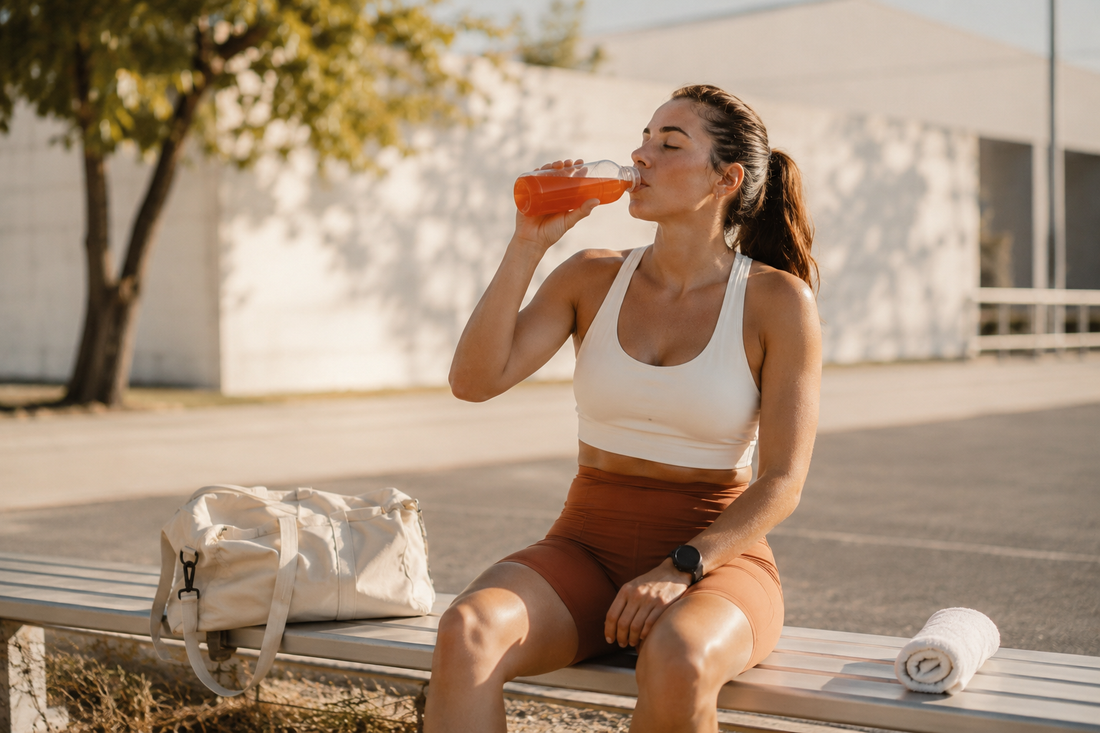
You just finished your workout, you are sweaty, and you are wondering what to drink.
Most people make one of these three choices:
- They drink water and hope it is enough
- They grab the first sugary drink in the gym fridge
- They drink nothing until they get home, sometimes 30 or 45 minutes later
Each choice covers part of the need, never all of it. Your body has just lost water, sodium and a good share of its glycogen, the carbohydrate reserve stored in your muscles.
This guide answers the question of what to drink after a workout to recover well, with the research to back it up. UQAM Sports also offers a post-workout recovery guide if you want to compare.
In this article:
- The 3 things your body needs after exercise
- What studies say about water, chocolate milk and electrolytes
- How much to drink, calculated with your bathroom scale
- A three-step plan, from the gym door to the next day
What to drink after a workout, the 3 needs of your body
Whatever your sport, your body has three things to replace.
- Water: replace the fluid lost in sweat
- Glycogen: refill the carbohydrate stores in your muscles and liver
- Electrolytes: replace the sodium and potassium you lost
A drink that covers only one need leaves the other two unmet.
- Water covers hydration
- Juice covers carbohydrates, but without sodium
- An effervescent tablet covers electrolytes, but without carbohydrates
A fourth need, muscle repair, comes from protein.
Is water alone enough after a workout?

After a walk or a light 20-minute session, yes. After an effort of more than 45 to 60 minutes, or a short but intense session, it leaves two needs unmet.
- No carbohydrates to recharge your energy reserves
- No sodium to help your body hold on to the water you drink
- A full-stomach feeling that makes you stop drinking before you have made up your loss
Researchers Maughan and Shirreffs sum it up in their review on restoring water and electrolyte balance. Full rehydration also requires replacing the electrolytes lost in sweat.
For what happens during the effort itself, read our article on how to hydrate during a run.
The recovery window, what the research says

People often talk about a magic 30-minute window after exercise. It matters mostly when time is short.
- You train twice on the same day
- Your next session is less than 8 hours away
- Your effort was long or very intense
A 2021 meta-analysis (29 trials, 246 participants) compares carbohydrates with water alone during recovery. Carbohydrates speed up glycogen resynthesis.
The studies test about 1 g of carbohydrate per kilo of body weight each hour.
For a 70 kg person, that is about 70 g of carbohydrates per hour. One Maple MC2 sachet provides 28 g, and your meal covers the rest.
If your next session is 24 hours away, you have more flexibility. A carbohydrate-rich meal in the following hours does the job.
Carbohydrates first, protein second
A ratio of 3 or 4 parts carbohydrate to 1 part protein shows up everywhere. The 2021 meta-analysis concludes, however, that adding protein does not speed up glycogen resynthesis when carbohydrates are sufficient.
Protein keeps a role in muscle repair.
The ISSN position stand on nutrient timing offers one option. When your carbohydrate intake stays modest, add 0.2 to 0.4 g of protein per kilo per hour.
To cover both, pair your sachet with a protein source:
- Greek yogurt
- Eggs and toast
- A protein shake
Key takeaway
Maple MC2 covers hydration, electrolytes and part of your carbohydrates. Protein comes from your snack or your meal.
Chocolate milk, smart pick or overrated?

Dairy Farmers of Canada and Swissmilk recommend it for its ratio of about 3 parts carbohydrate to 1 part protein.
The province's Chief Scientist reaches a different conclusion. A 2017 meta-analysis of 33 studies found no advantage of chocolate milk over a placebo or a sports drink.
Chocolate milk remains a decent choice that is cheap and easy to find. It has three limits to know about:
- Lactose can cause discomfort right after an intense effort
- It sits heavier in the stomach than a water-based drink
- It does not suit vegans
How much to drink after a workout, the bathroom-scale math
A simple calculation replaces guesswork.
- Weigh yourself before your workout
- Weigh yourself after, once you have towelled off
- Work out the difference in kilos
Each kilo lost equals about 1 litre of fluid. The American College of Sports Medicine recommends drinking about 1.5 times that amount over the following hours, to make up for what urine removes.
If you lose 1.2 kg during your session, aim for about 1.8 litres of fluid over the next few hours. Add sodium to help you hold on to it.
Sodium, potassium and calcium, what your sweat takes with it
Your sweat contains mostly sodium, and a little potassium. The amount varies a lot from one person to the next, and from one day to the next.
- Sodium helps your body hold on to the water you drink
- Potassium supports muscle function and fluid balance
- Calcium also plays a role in muscle contraction
One Maple MC2 sachet contains 273 mg of sodium, 94 mg of potassium and 47 mg of calcium.
That adds up to 414 mg of electrolytes. Read our article on natural electrolytes and their benefits for the details.
If cramps keep showing up after your sessions, also check how to avoid muscle cramps in sports.
Recover with all three flavours
Maple, Maple-Blueberry, Maple-Peach. 12 sachets to find your favourite after training.
Discovery Box | $29.99What to avoid after exercise
Some drinks slow your recovery instead of helping it.
- Alcohol: it increases urine output, which can slow rehydration
- Energy drinks: a lot of sugar and caffeine, and often little sodium depending on the label
- Concentrated juices: carbohydrates without sodium, and excess fructose can upset your stomach
- Brightly coloured sports drinks: read the ingredient list, you will often find artificial colours and flavours
- Nothing at all: waiting 30 to 45 minutes delays your recovery for no reason
After which workouts recovery matters most

Not every workout calls for the same attention.
- Runs of more than 45 minutes: heavy sweat loss and depleted glycogen, see our guide to the best hydration drink for runners and the runners collection
- Cycling or cardio in the heat: sodium loss climbs, the cyclists collection answers that need
- Intense weight training: less sweat, but carbohydrates and protein both count, see the fitness and CrossFit collection and our CrossFit electrolyte guide
- Hyrox or triathlon: long sessions back to back, read our Hyrox and triathlete guides
- Walk or 20-minute session: water is enough
For efforts longer than 3 hours, compare with our article on the natural Maurten alternative. Before the effort, the pre-workout collection gets your body ready.
Industrial powder or maple, what is in your glass
Take any store-bought recovery powder. Turn the container over and read the ingredient list.
Depending on the brand, you often find:
- Maltodextrin or dextrose in first position
- Refined sugars or glucose-fructose syrup
- Artificial colours
- Artificial flavours
Maple syrup has a glycemic index of 54, compared with 65 for refined sugar. These USDA figures are cited in this study.
A lower index means a slower rise in blood sugar.
A Université Laval study in mice also showed favourable effects of maple on gut microbiota. The results still need to be confirmed in humans.
| Criterion | Typical industrial powder | Maple MC2 |
|---|---|---|
| Carbohydrate source | Maltodextrin, refined sugars | Organic maple syrup |
| Electrolytes | Varies by brand | 414 mg (sodium, potassium, calcium) |
| Carbohydrates and calories | Varies by brand | 28 g and 110 kcal per sachet |
| Ingredients | Artificial colours and flavours are common | Organic maple syrup, salt, freeze-dried fruit, natural flavours |
| Format | Large tub or bottle | Pre-measured single sachet |
| Origin | Varies by brand | Saint-Ours, Montérégie |
To go further, read our comparison of maple versus artificial sugars and our article on the benefits of maple syrup in sports nutrition.
Digestion after exercise and the FODMAP profile
After an intense effort, your digestive system can be more sensitive than at rest. Drinks high in polyols or concentrated sweeteners then cause bloating more easily.
Gourmend Foods cites Monash University for pure maple syrup. It is low FODMAP up to 2 tablespoons (about 50 g) per meal.
The Maple-Blueberry and Maple-Peach flavours contain freeze-dried fruit. Try them in training before a big session if your stomach is sensitive.

Your recovery plan in three steps
Within 30 minutes after the effort
Drink a first glass with carbohydrates and electrolytes. One Maple MC2 sachet in 350 to 500 ml of water provides 28 g of carbohydrates and 414 mg of electrolytes.
Within the next 2 hours
Have a meal or a snack with carbohydrates and protein. If your next session is coming up, a second diluted sachet adds carbohydrates and electrolytes.
What to drink after sport when you train twice a day
Keep a sachet in your bag for the break between the two sessions. Add a full meal, because a sachet alone does not refill everything.
The next day
Keep hydrating all day long. Add a little sodium if you sweated a lot the day before.
Do you need a special drink after every workout?
No. It depends on duration, intensity and heat.
- Under 30 minutes, light effort: water is enough
- 45 to 60 minutes, moderate effort: water and a snack with carbohydrates and salt
- Over 60 minutes, hard effort or heat: a drink with carbohydrates and sodium, then a meal
The closer your next session, the more the carbohydrates matter.
How to prepare your recovery sachet
Preparation takes less than a minute.
- Pour one sachet into 350 to 500 ml of water
- Shake it, cold or room-temperature water both work well
- Drink it right away, or prepare it before you leave and keep it cool
A slight residue at the bottom of the bottle is normal. It comes from the maple syrup, which replaces synthetic sweeteners here.
Which flavour to choose after training
The three flavours provide the same electrolytes, 414 mg per sachet. The choice comes down to taste.
- Maple, the original recipe with maple syrup and electrolytes, no fruit
- Maple-Blueberry, smooth and lightly fruity
- Maple-Peach, light and refreshing
If you cannot decide, the Discovery Box holds 12 sachets, with 4 of each flavour. Each sachet costs $2.79, or $29.99 a box.
Frequently asked questions
In summary
You used to leave the gym with a bottle of water, a neon drink or nothing at all. None of those options covers the three needs of your body.
Now you know what to drink after a workout. Water, carbohydrates and sodium within the hour, then a meal with protein.
Discover our post-workout recovery collection and pick your flavour: