In the sports drink market, the vast majority of products contain at least one of these ingredients:
- Maltodextrin
- Artificial sweeteners
- Synthetic colors and flavors
Am I wrong to say that you don't even know what these words mean?
Maple syrup, on the other hand, is a single ingredient. Not a list.
Here's what scientific research really says about the benefits of maple syrup for sports and sports nutrition.
Why most sports drinks are problematic

Grab any bottle from the shelf. Turn it over. Read the ingredient list.
You'll probably find:
- Maltodextrin, a carbohydrate processed from corn starch
- Artificial flavors for a taste that doesn't exist in nature
- Colorings to make the liquid blue, orange, or green
- Preservatives for long shelf life
- Sometimes sucralose or acesulfame-K as a sweetener
These ingredients exist for a reason: to produce on a large scale, at a low cost.
Not for your performance.
What maple syrup truly contains
Maple syrup comes from maple sap. Period.
No chemical transformation, no lab additives. A single ingredient that provides carbohydrates, minerals, and antioxidants.
A comprehensive scientific review of the nutritional properties of maple (Nutrients, 2023) confirms the presence of over 60 bioactive compounds, including quebecol, a polyphenol unique to maple syrup.
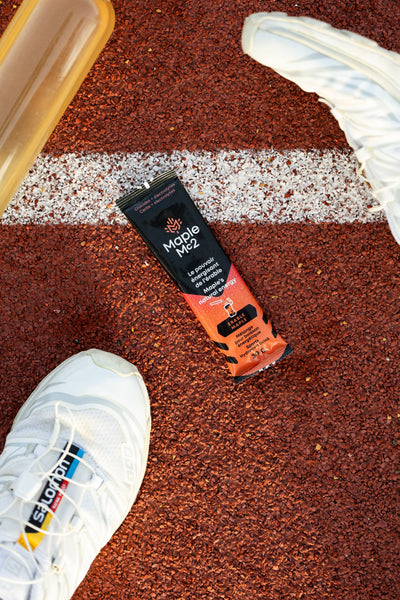
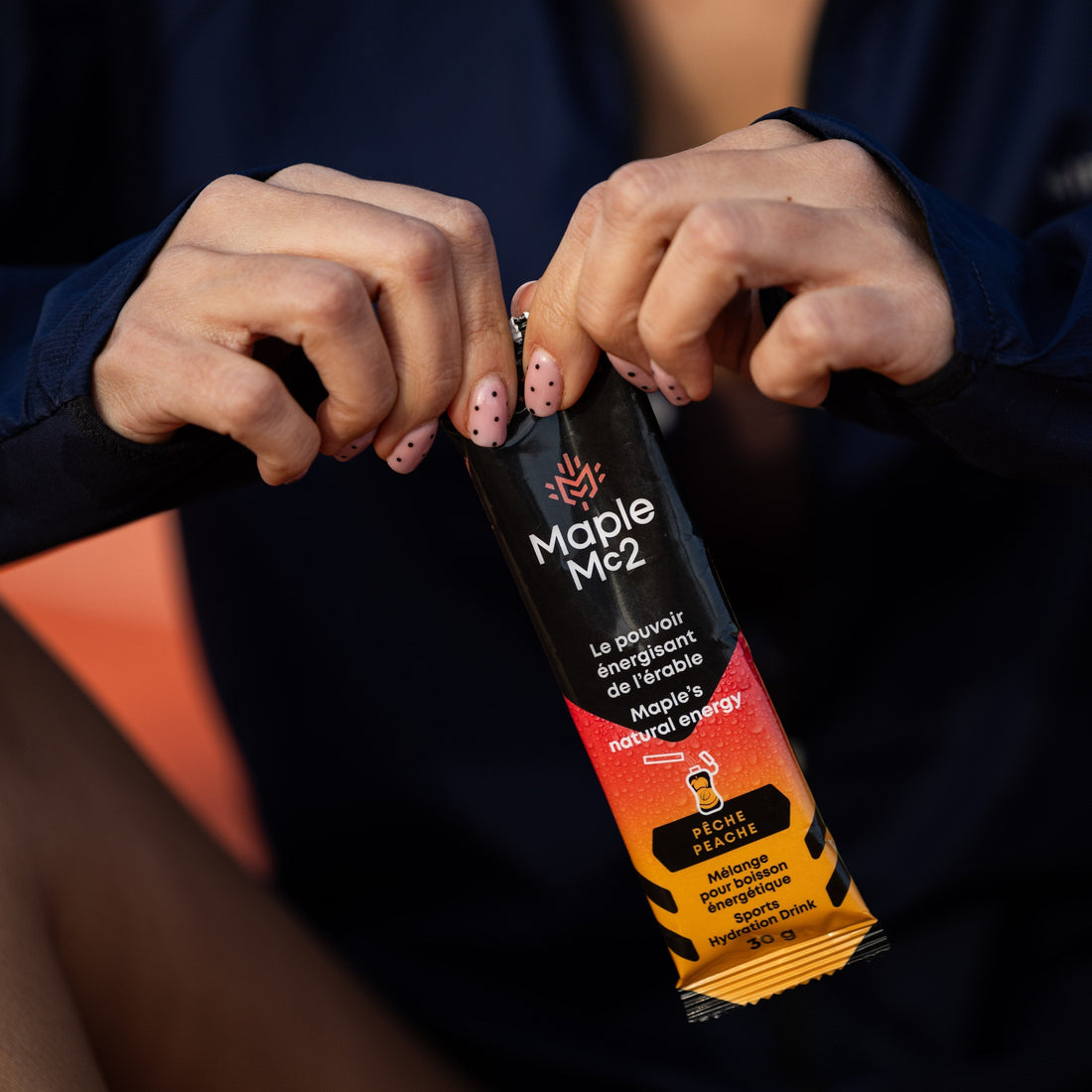
Each Maple MC2 sachet contains:
- 28g of carbohydrates (natural sucrose, glucose, and fructose)
- 273mg of sodium
- 94mg of potassium
- 47mg of calcium
- 11mg of magnesium
- 3.3mg of manganese (143% of daily value)
- 110 kcal
These are exact figures, not estimates. They come from organic maple syrup, not a synthetic blend.

To remember
Glycemic index of maple syrup: 54, according to the International Tables of Glycemic Index (Foster-Powell et al., 2002).
Maltodextrin: 85-105.
The lower the index, the more stable the energy during exercise.
Note: Some more recent sources place the GI of maple syrup between 54 and 65 depending on the measurement method and the batch tested.
Quebecol: the compound found only in maple
In 2011, a team from Université Laval identified a polyphenol found in no other food: quebecol. This compound forms during the boiling of maple sap when making syrup.
Preliminary research on quebecol shows measurable anti-inflammatory properties. A study published in Bioorganic & Medicinal Chemistry Letters (2011) demonstrated that quebecol inhibits certain enzymes linked to inflammation.
For an athlete, inflammation is a natural process after exercise, but excessive inflammation delays recovery. No salt or maltodextrin formula contains quebecol or comparable polyphenols.
Research on quebecol is still young. We cannot claim that it directly improves sports performance. But it is a unique bioactive compound, present in every Maple MC2 sachet, that industrial drinks do not reproduce.
Maple electrolytes: real sports fuel
Sodium and potassium play a direct role in hydration during exercise.
According to Maple from Quebec, maple syrup-based drinks provide sugars readily usable by muscles and electrolytes to replace some of the losses in sweat.
This is exactly what a Maple MC2 sachet reproduces: 273 mg of sodium and 94 mg of potassium, diluted in water, ready even before you start.
Sodium is the main electrolyte lost in sweat. One liter of sweat contains an average of 900 mg of sodium. The presence of carbohydrates (like sucrose from maple syrup) improves intestinal absorption of sodium via the glucose-sodium co-transport, a mechanism validated by the World Health Organization in its oral rehydration solutions.

Digestion and exercise tolerance: the angle no one addresses
Bloating, side stitches, nausea. This is the lot of many athletes who consume industrial drinks during exercise. Between 30 and 50% of endurance runners report gastrointestinal problems in competition.
Maple syrup has a concrete advantage here: it is classified Low FODMAP by Monash University, unlike honey or agave syrup. It does not contain detectable amounts of fermentable carbohydrates responsible for bloating (excess free fructose, polyols, fructans).
A double-blind randomized clinical trial also demonstrated that replacing refined sugar with maple syrup improves gut microbiota composition and reduces several cardiometabolic risk factors.
For an athlete, this means less digestive discomfort and better tolerance during prolonged efforts.
Try all three flavors
Maple, Maple-Blueberry, Maple-Peach. 12 sachets to find your favorite.
Discovery Box | $29.99The key study: maple syrup and perceived exertion
The most directly relevant study for athletes is that of St-Pierre et al., published in the Journal of the International Society of Sports Nutrition (2020).
Protocol: randomized, double-blind, crossover clinical trial. Participants performed prolonged exercise sessions consuming either a maple syrup-based drink, a placebo drink, or a commercial drink.
Results:
- The maple syrup-based drink reduced the perception of effort (RPE, Borg scale) compared to placebo.
- Participants reported better taste appreciation compared to commercial drinks.
- No significant difference in measured physical performance between the maple drink and the commercial drink.
What this means: maple syrup works as well as a classic sports drink to maintain performance, while being perceived as less difficult by the athlete. Perceived exertion is a real performance factor, especially in endurance: when the effort feels lighter, you last longer.
Study limitations: small sample size, laboratory protocol (not real competition), and only one session per condition. Larger studies in real conditions would be needed to confirm these results.
Maple vs sports drinks: the comparative figures
| Criterion | Maple (Maple MC2) | Gatorade (industrial reference) | Skratch Labs ("real food") |
|---|---|---|---|
| Ingredients | 1 (organic maple syrup) | 7+ (water, sugar, dextrose, citric acid, salt, sodium citrate, flavor) | 5-6 (cane sugar, sodium citrate, fruit juice, salt, magnesium citrate) |
| Sodium / serving | 273 mg | 160 mg (355 ml) | 400 mg |
| Glycemic index | 54 | 89 (dextrose + sugar) | ~65-70 (estimated) |
| FODMAP | Low FODMAP | Not certified | Not certified |
| Colorants / flavors | None | Yes (artificial colors + flavors) | No (real fruit juice) |
| Polyphenols / antioxidants | 60+ compounds (including quebecol) | None | Traces (fruit juice) |
| Made in Canada | Yes (Quebec) | No | No |
The limits of maple syrup for sport
Maple syrup is not the perfect solution for all sports scenarios. Here are its real limitations:
Moderate sodium for extreme efforts. With 273 mg of sodium per sachet, Maple MC2 well covers the needs for an effort of less than 90 minutes. But for a marathon at 30°C or an Ironman triathlon, where sweat losses exceed 1.5 liters per hour, formulas with 800-1,000 mg of sodium per serving (like LMNT or Organika) are better suited.
Non-negligible calories. A sachet contains 110 kcal. For athletes looking for zero-calorie hydration (keto diet, weight loss), this is not the right product.
Non-optimized glucose:fructose ratio. Endurance science shows that a 2:1 glucose:fructose ratio maximizes gastric emptying rate and intestinal carbohydrate absorption beyond 60g/hour. Maple syrup is primarily sucrose (a 1:1 ratio once digested), which is effective but not optimal for ultra-endurance athletes looking to absorb more than 90g of carbohydrates per hour.
Limited flavor range. Three flavors (Maple, Maple-Blueberry, Maple-Peach) compared to 8+ for Skratch Labs or 10+ for Nuun. For very long efforts, flavor variety helps maintain palatability.
Where this scientific validation comes from
Maple MC2 was born in Saint-Ours, Montérégie. A family sugarbush, organic maple syrup.
The Quebec Maple Syrup Producers closely follow research on maple and sports performance. Their most recent assessment confirms a real interest in maple as a natural solution to commercial products, particularly regarding perceived exertion.
It's not just a local trend. It's an actively pursued research area in Quebec, with ongoing clinical studies and results published in peer-reviewed journals.

How to use maple syrup in sports nutrition
Before exercise
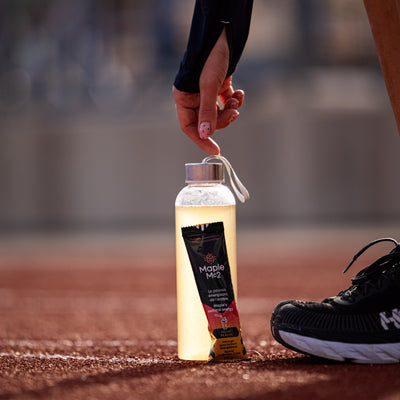
One sachet in 500 ml of water, two hours before starting.
The 28g of carbohydrates provide an energy reserve without overloading the stomach. The moderate glycemic index (54) avoids the insulin spike followed by a drop that can impair the first minutes of effort.
During exercise
Beyond 60 minutes, one sachet every 45 to 60 minutes.
This is exactly the protocol tested in the study by St-Pierre et al. (2020) where participants reported a reduced perception of effort with the maple drink.
After exercise
Within 30 to 60 minutes after finishing.
Natural electrolytes replace what you lost in sweat. Carbohydrates restart muscle glycogen synthesis. Polyphenols and quebecol help modulate post-exercise inflammation.

Frequently Asked Questions
In summary
On one side: a list of ingredients you can't name or trace.
On the other: a single ingredient, whose benefits for sports and sports nutrition are studied in published clinical trials, not just in local marketing.
Maple syrup checks the boxes: stable energy, natural electrolytes, digestive tolerance, unique polyphenols. It also has its limits: moderate sodium, non-zero calories, 1:1 glucose:fructose ratio.
For most workouts, it's a complete solution in a single sachet. For extreme efforts, it can be combined with other sources.
Discover our maple, maple-blueberry, and maple-peach flavors, or try them all with the discovery box.
Looking to compare with other electrolyte drinks? Check out our ranking of the best natural electrolyte drinks in Canada.