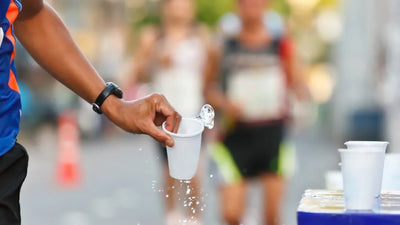
You're training for a 10 km and want to know what to drink. Ask the question about your weeks of preparation, since those sessions are where you spend the vast majority of your effort time.
A 10 km training plan includes several types of sessions, and their hydration needs differ.
Your long run is the session that counts the most
In a 10 km training plan, the weekly long run often lasts longer than the target race itself. It frequently reaches 70 to 90 minutes, sometimes more depending on your level and time goal.
It's the session of the week most likely to go past the 60-minute threshold. Beyond that point, carbohydrates and sodium become useful.
Key Takeaway
According to the ACSM, water is enough for efforts under 60 minutes. Between 60 and 150 minutes, 30 to 60 g of carbohydrates per hour help you maintain your pace.
Many 10 km training long runs fall directly into this zone, even if the target race doesn't always get there.
Calculate the duration of your long runs

Your long run is usually slower than your target race pace. It therefore lasts even longer than your 10 km on race day.
- 12 km at 6 min/km: 72 minutes, above the threshold
- 14 km at 6:30 min/km: about 91 minutes, well above
- 10 km at 5:30 min/km: 55 minutes, close to the threshold
If your long run goes past 60 minutes, which happens often even with a 10 km goal, take carbohydrates during that session. You need them regardless of what your race will require on the big day.
Your different types of sessions, at a glance
| Type of session | Typical duration | Needs during the session |
|---|---|---|
| Easy run | 30 to 50 min | Water is usually enough |
| Tempo or interval session | 45 to 60 min total | Hydration mostly before the session |
| Weekly long run | 60 to 90 min | Carbohydrates and sodium during the run |
Your interval or tempo session
Your quality sessions (intervals, tempo) for a 10 km often last 45 to 60 minutes in total, warm-up and cool-down included. High intensity increases your sweat rate, so hydrating before the session helps you keep the quality of your repetitions to the end.
Before a long tempo session, a packet of Maple MC2 diluted in a bottle gives you 28 g of carbohydrates and 273 mg of sodium. That's a reasonable dose for a session of this intensity.
Maple MC2 Maple
$2.79 per packet, $2.50 in a box of 12 ($29.99)
For whom: the runner preparing for a 10 km who wants a simple carbohydrate and sodium boost for long runs and quality sessions.
- 414 mg of electrolytes per packet: sodium 273 mg, potassium 94 mg, calcium 47 mg
- 28 g of carbohydrates and 110 kcal, made from Quebec maple syrup
- Dissolves easily in a small bottle or a soft flask for training
Your easy runs remain the foundation that supports everything else
Between the long run and the quality session, your easy runs of 30 to 50 minutes usually stay under the 60-minute threshold. Water is enough before and after.
Your hydration between sessions still matters, because a 10 km training week includes 4 to 6 runs. If you show up poorly recovered, accumulated fatigue hurts your long runs and quality sessions.
Routine before your key sessions
Before a long run or a quality session, your routine counts as much as what you drink during the effort. It happens in three steps:
- 2 to 3 hours before: a light, carbohydrate-based breakfast
- 1 to 2 hours before: a glass of water
- In the hours leading up: avoid fibre and fatty foods, which slow digestion during the session

Adjust your intake according to the terrain of your route
A hilly route increases your energy expenditure compared to a flat one, even over the same distance. Adjust your carbohydrate intake to the terrain of each run:
- Marked hills: aim for the high end of your personal range
- Very flat route: you can stay at the low end of your range without risking fatigue
By following the terrain of each run, you avoid both an unnecessary surplus and a shortfall.
Solid nutrition around your sessions
Your drink covers hydration and part of your carbohydrates. After a long run or a quality session, a meal that combines carbohydrates and protein within the hour helps muscle recovery.
A bowl of cereal with milk or a fruit and yogurt smoothie usually does the job.
- Easy runs: no special adjustment is needed
- Long runs approaching 90 minutes: a banana or a few dates on top of the diluted packet can help if you feel a dip toward the end
Running in a group or club changes the logistics

In a group or club, the long run is often done at a shared pace, faster or slower than your usual one. The duration of your session therefore changes compared to a solo run.
Bring your own supply instead of counting on what others bring. You avoid surprises if the group doesn't stop when you need it to.
How to calculate your own intake based on your weight
In sports nutrition, a common approximation is about 0.5 to 0.7 g of carbohydrates per kilo of body weight per hour. It applies to your 10 km training long runs:
- 65 kg runner: about 32 to 45 g per hour, a little more than one Maple MC2 packet
- 80 kg runner: closer to 40 to 56 g per hour
For sodium, the only reliable way to know your own rate is the weigh-in test before and after a long run. Do it without drinking, or by noting exactly what you drink.
Significant weight loss signals heavy sweating. It justifies a sodium intake closer to the high end of the ACSM range.
Summer 10 km vs. winter 10 km
- Summer training: heat and humidity increase your needs in every session, even the short ones
- Winter training: the risk drops during the effort, but cold air increases your respiratory losses and masks the feeling of thirst
In winter, many runners therefore underestimate their needs between runs.
Pacing and nutrition in training go together
A sports drink doesn't make up for a long run started too fast. Many runners fade at the end of a run because they started too close to their race pace, not because they lacked carbohydrates.

If you always slow down at the end of your long runs, try a more cautious start before blaming nutrition. Both matter, but starting pace is often the first factor to correct.
How to know if your hydration plan is working
Three signs show that your approach is the right one:
- End of the long run: no marked dip in energy in the final kilometres
- Recovery: you recover well from one session to the next
- After the effort: no headaches after your hardest sessions
Fix these warning signs the first time you see them, well before race day:
- fatigue that builds week after week
- long runs where the final kilometres slow down noticeably
- repeated dark urine after exercise
Your intake also evolves between the base phase and the specific phase
- Base phase: early in your preparation, your long runs stay shorter and slower, so a light intake is enough
- Specific phase: in the 3 to 4 weeks before the race, your long runs and quality sessions get closer to your target pace. Your energy expenditure goes up at the same duration.
Increase your intake at the same rate as the intensity of your sessions.
Integrate your intake plan into your training weeks
Test your carbohydrate and sodium intake on your training long runs, well before race day. If you notice digestive discomfort, adjust the concentration or how often you sip the next time.
These preparation weeks are where you find your own routine. That's the one that will work on race day.
What to do if a session doesn't go as planned
If you feel a sudden drop in energy in the middle of a long run despite a planned intake, slow down rather than stopping completely. A small extra intake, even outside your usual plan, is better than finishing the session empty.

Afterward, write down what happened:
- the time of your last meal
- the temperature
- how much you drank
These details help you adjust your approach for the next long run instead of repeating the same mistake.
The 10 km splits runners into two groups
The 5 km is almost always run under the 60-minute threshold, and the half-marathon almost always above it. For the 10 km, it all depends on your own pace.
To adjust:
- calculate your usual race time
- find yourself in the table above
- adjust your intake on your long runs and quality sessions
Common mistakes in 10 km preparation
- Not drinking during the long run because "it's only training," when it often goes past the 60-minute threshold
- Showing up to a quality session poorly hydrated because you didn't pay attention in the days before
- Testing a new product on a long run without trying it on a shorter run first
- Underestimating your needs in winter because you feel less thirsty
- Keeping the same intake in the specific phase as in the base phase, without accounting for the higher intensity
Want to compare several brands of hydration drinks? Our comparison dedicated to runners covers this in detail.
Want to see how your needs change with your training distance? Check out our guide by distance.
Frequently Asked Questions