You go for a run with a water bottle. You drink when you're thirsty.
You finish your 10K with a headache, a bloated stomach, or jelly legs, without really knowing why.
Most runners manage their hydration with vague, often contradictory rules:
- "Drink before you're thirsty," but no one says how much
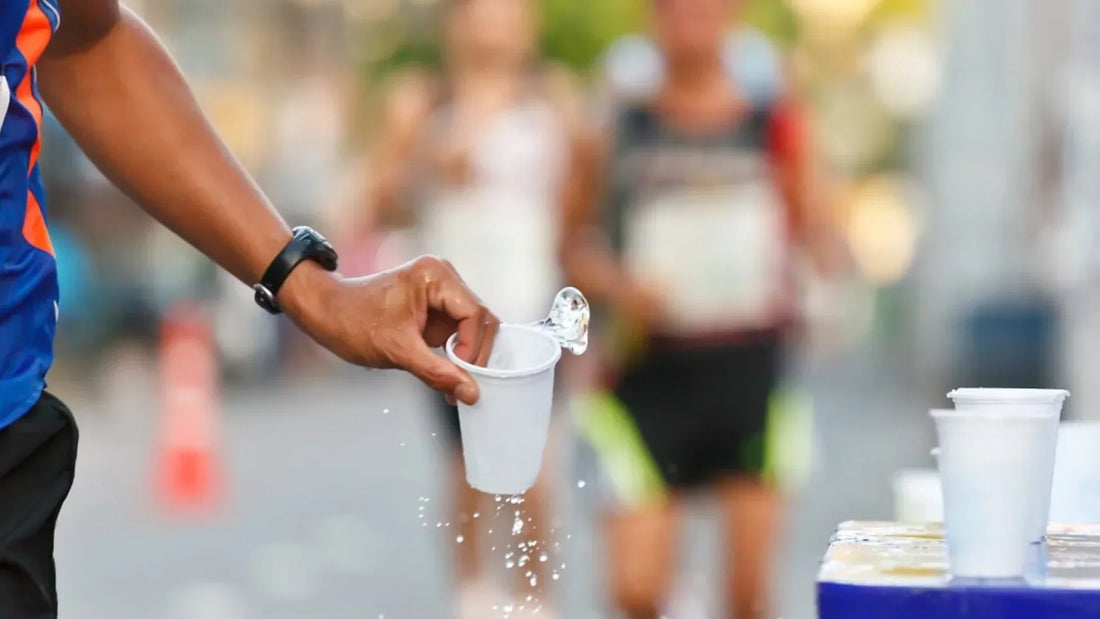
- "Take a sip at every aid station," regardless of the distance between stations
- "The more you drink, the less risk of dehydration," a myth that has caused hospitalizations in marathons
The problem isn't your motivation. It's the lack of clear guidelines.
Here's how to hydrate during a run with a protocol based on sports science, not habits copied from one runner to another.

How to hydrate during a run: what actually happens in your body
Drinking water in the office and drinking during a running workout are not the same mechanism.
During exertion, your body sweats to dissipate the heat produced by your muscles. This sweat contains water, but also sodium and other electrolytes.
The longer and more intense the effort, the more you lose:
- Water, which reduces your blood volume
- Sodium, essential for retaining this water in your cells
- Glycogen, your muscle energy reserve
Replacing only water without the rest is correcting one part of the problem while ignoring the other.
Dehydration or hyponatremia: how to recognize the signs
Two opposing problems can occur during a race, and they are easily confused.
Dehydration happens when you lose more water than you absorb. Common signs:
- Intense thirst
- Dry mouth, dark urine
- Sudden fatigue, cramps
- Dizziness at the end of the race
Hyponatremia, on the other hand, occurs when you drink too much water and dilute your blood sodium below the normal threshold. A scientific review on exercise-associated hyponatremia reports a prevalence of 7% to 15% in ultra-distance runners, almost always caused by overhydration.
Its signs:
- Nausea, headache
- Confusion, disorientation
- Swelling of hands or ankles
- Muscle weakness
To remember
The symptoms of both conditions are similar. If you feel unwell after drinking a lot, the solution is not to drink even more. This is often the opposite of the natural reflex.
How much to drink per hour depending on your intensity and the weather

The most cited benchmark in sports science remains that of the American College of Sports Medicine: for efforts lasting more than an hour, aim for 600 to 1200 ml of fluid per hour, with 4% to 8% carbohydrates.
In practice, for recreational running, this translates to a simpler range to remember:
- 400 to 600 ml/hour in cool or temperate weather
- 600 to 800 ml/hour in hot or humid weather
- In small, regular sips, not all at once every 20 minutes
For a run of less than 60 minutes, without excessive heat, water is perfectly sufficient. The protocol above becomes particularly relevant for a 10K (1+ hour jog) or a prolonged training session.
The role of electrolytes, especially sodium, during prolonged exertion
Sodium is not an optional supplement. It has a specific mechanical role.
It helps your body retain the water you drink, instead of simply urinating it out. The literature on water and electrolyte needs during exercise recommends including 0.5 to 0.7 g of sodium per liter of beverage for efforts lasting more than an hour, partly to prevent hyponatremia.
Concretely, this means:
- Drinking only plain water during prolonged exertion dilutes your sodium instead of replacing it
- Potassium and calcium also play a role in muscle contraction
- A well-dosed electrolyte drink is more palatable than a too sweet or too salty drink
A Maple MC2 sachet provides 273 mg of sodium, 94 mg of potassium, and 47 mg of calcium, for a total of 414 mg of electrolytes. This is no accident: it's calibrated for about an hour of effort.
Your sweat rate remains personal. Two runners can lose very different amounts of sodium for the same effort.
A simple test: weigh yourself before and after a long run, without drinking or eating in between. Each kilogram lost represents approximately one liter of fluid to be replaced.
Why water alone is no longer enough after 60 to 90 minutes
Your body runs on glycogen, a carbohydrate reserve stored in your muscles and liver.
This reserve begins to deplete after 60 to 90 minutes of sustained effort. This is the famous "wall" that many runners dread.
To delay this depletion, the recommendation for long-distance running is to ingest 30 to 60 g of carbohydrates per hour. Water alone provides none of these carbohydrates.
This is why serious hydration protocols always separate two needs:
- Replacing water lost through sweat
- Providing carbohydrates and electrolytes to support effort
Common mistakes made by runners
Most hydration problems come from two extremes.
Drinking too much, for fear of dehydration:
- Drinking at every aid station without being thirsty
- Drinking only plain water for an entire marathon
- Ignoring signs of swelling or confusion
Not drinking enough, for fear of bloating or forgetting:
- Waiting until you're thirsty to drink, which is already too late
- Skipping hydration on 45 to 60-minute runs that end up being longer
- Never testing your strategy in training before an official race
Both extremes often stem from a lack of concrete benchmarks. Once you know your approximate hourly volume and have a reliable electrolyte drink, the decision becomes almost automatic.

Adapting your hydration to the race distance
The protocol changes depending on the distance. Here are starting points, to be adjusted according to your sweat rate and the weather.
- 5 km: water is sufficient in most cases. A sip before starting is plenty.
- 10 km: depending on your pace, the effort lasts 45 to 70 minutes. An MC2 sachet diluted in your bottle starts to make a difference, especially in summer.
- Half-marathon: between 1h30 and 2h30 of effort. Glycogen starts to run low. This is the format where the carbohydrate + electrolyte protocol becomes really relevant.
- Marathon and ultra: several hours of effort, several electrolyte drink intakes necessary, with a real risk of hyponatremia if you only compensate with water.
In all cases, test your strategy in training. Race day is never the right time to try a new drink.
Industrial sports drinks vs. natural maple option
Grab any sports drink from a convenience store. Turn it over. Read the ingredient list.
You will almost always find one of these three elements:
- Maltodextrin, a fast-absorbing industrial carbohydrate
- Refined sugars or artificial sweeteners
- Synthetic colorings or flavorings
Maltodextrin has a glycemic index estimated between 85 and 105, which causes a rapid blood sugar spike followed by a drop. Maple syrup, on the other hand, has a glycemic index of about 54, meaning a more gradual energy release.
Maple naturally contains carbohydrates and minerals, without industrial processing. A study conducted on 76 subjects evaluated a maple-based drink as a source of carbohydrates and electrolytes during exercise.
Try all three flavors
Maple, Maple-Blueberry, Maple-Peach. 12 sachets to find your favorite before your next run.
Discovery Box | $29.99Comparison table: industrial drink vs. Maple MC2
| Criterion | Industrial sports drink | Maple MC2 |
|---|---|---|
| Carbohydrate source | Maltodextrin, refined sugars | Organic maple syrup |
| Glycemic index | 85 to 105 | Around 54 |
| Sodium | Varies by brand | 273 mg / sachet |
| Total electrolytes | Often sodium only | 414 mg (sodium, potassium, calcium) |
| Additives | Frequent artificial colors, flavors | None |
| Origin | Mass industrial production | Saint-Ours, Montérégie |
| Format | Bottle or measuring powder | Pre-dosed sachet |
Digestion and gastric tolerance during exertion
Your stomach slows down during exertion. This is normal: blood is redirected to your muscles.
This is why some sports drinks cause bloating or cramps during a run. Fructans and certain fermentable sugars are often the culprits.
Maple syrup is considered low in FODMAPs in small portions, one of the criteria used to predict digestive tolerance.
Researchers at Laval University also observed, in a study published in the American Journal of Physiology, a link between maple syrup consumption and a favorable modification of the gut microbiota, with a reduction in rapid glucose absorption.
The concrete result for a runner: fewer sudden blood sugar spikes, and a unique ingredient that is easier to digest than a list of ten additives.
This does not mean zero risk for everyone. Some stomachs are more sensitive than others, regardless of the drink.
The rule remains the same: start with a small amount in training, gradually increase, and note how your body reacts before applying a new strategy on race day.

How to integrate maple into your hydration during a run
Before the effort
Drink 300 to 500 ml of water in the two hours before starting.
You can take a Maple MC2 sachet about 30 minutes before, to start with your glycogen reserves full.
During the effort: how to hydrate kilometer after kilometer
Prepare your bottle with a sachet diluted in 500 ml of water if your run exceeds 60 minutes.
Drink in small sips, about every 15 to 20 minutes, rather than a large amount all at once.
After the effort
Rehydration continues after the finish line. Aim for about 1.5 times the lost weight in liquid, in liters.
A second sachet helps replace lost sodium and restart muscle glycogen replenishment.
Frequently asked questions
In summary
On one hand: drinking randomly, without guidance, with the risk of doing too much or too little.
On the other hand: a clear protocol, based on sports science, that finally answers the question of how to hydrate during a run without guessing.
This protocol can be summed up in three words: water, electrolytes, carbohydrates, in the right proportions and at the right time.
No need for complicated calculations for each outing. Once your strategy is tested in training, it becomes a reflex, race after race.
Maple MC2 combines all three in a single sachet made from organic maple syrup, without maltodextrin or additives.
- Maple, the benchmark flavor for running
- Maple-Blueberry
- Maple-Peach
- Discovery Box, to test all three before your next race
You can also explore our sports drink for runners collection to find the format that suits your mileage.