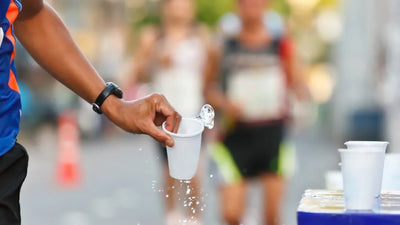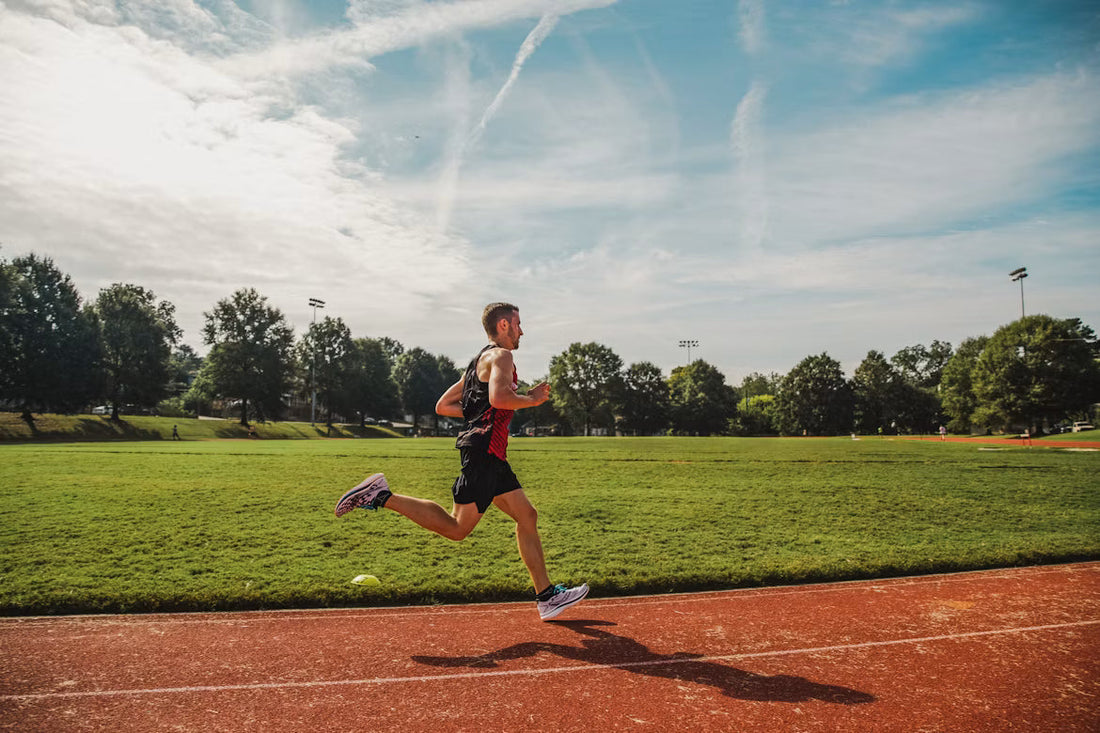
You're training for a 5 km and wondering what to drink. On race day, the effort lasts 20 to 35 minutes and water is almost always enough.
The question comes up during the weeks of preparation, when you train 3 to 5 times a week. Most 5 km guides miss it.
Why training and racing are not comparable
A competitive 5 km lasts 20 to 35 minutes. A typical training week includes several different sessions:
- Easy run, at a relaxed pace
- Speed work, with recovery between reps
- Longer run, sometimes, to build endurance
Some of these sessions last much longer than the race itself.

A long training run can last 45 to 70 minutes, even when you're aiming for a 5 km.
With recovery intervals, a speed session also stretches over 40 to 50 minutes in total. The effort time itself is shorter.
A sports drink becomes useful on these longer sessions, well before race day.
Key takeaway
According to the American College of Sports Medicine (ACSM) guidelines, water is generally enough for efforts under 60 minutes. Beyond that, carbohydrates and sodium become useful.
Several sessions in a 5 km training week go past this threshold, even if the target race never does.
A typical 5 km training week, session by session
| Session type | Typical duration | Needs during the session |
|---|---|---|
| Easy run | 20 to 40 min | Water is enough in the vast majority of cases |
| Speed work (with recovery) | 45 to 60 min total | Mostly hydration before the session |
| Weekly long run | 45 to 75 min | Carbs and sodium if it goes past 60 min |
| Post-session recovery | Immediate | Electrolyte sachet recommended |
Most runners training for a 5 km look only at the race and overlook this table. Yet it's what sets your hydration needs over a full training cycle.

On your easy runs, water is almost always enough
Most of your 5 km training volume is done at an easy pace, over 20 to 40 minutes. On these runs, water before and after remains the baseline.
During the run, you normally don't need anything, except in the middle of summer heat. The other two types of sessions in your week need more attention.
Your speed session puts your hydration to the test
A typical 5 km speed session often lasts 45 to 60 minutes in total, warm-up and cool-down included. For example, 6 to 8 reps of 400 m to 800 m, with recovery between each one.
The high intensity increases your sweat rate, even if the work time stays under the 60-minute threshold. If you show up already slightly dehydrated from a busy day, the quality of your reps suffers.
For this session, hydration beforehand matters more than what you drink during the 5 km race itself.
Which format to choose for each session
The right format depends on the type of session:
- Easy run under 45 minutes: water is generally enough.
- Speed work: the high intensity makes a gel impractical between reps. Show up well hydrated before the session, since catching up during the effort is hard.
- Long run: a sachet mixed in a small bottle remains the simplest format. It combines hydration and carbs in a single dose, while a gel needs separate water.
Solid nutrition around your sessions

Your drink doesn't do all the work around your key sessions.
- Before speed work or a long run: a small meal high in carbs and low in fibre, 2 to 3 hours ahead. A banana or toast with jam fills your glycogen stores without weighing down your stomach.
- After a demanding session: a meal with carbs and protein within the hour helps muscle recovery. Add your electrolyte sachet.
- Easy runs under 40 minutes: no particular dietary adjustment is needed.
Your weekly long run is the session to watch
Even in a 5 km training plan, a longer run each week is common to build base endurance. It often lasts 45 to 75 minutes at a moderate pace.
It's the session of the week that most often goes past the 60-minute threshold. According to ACSM guidelines, carbs and sodium become useful beyond that threshold.
Depending on how long this run lasts, take a Maple MC2 sachet before or during it. It covers part of your carb and sodium needs for this session, even if your 5 km race will never call for it.
Maple MC2 Maple
$2.79 per sachet, $2.50 in a box of 12 ($29.99)
For whom: the runner training for a 5 km who wants a simple drink for long runs and recovery between sessions.
- 414 mg of electrolytes per sachet (sodium 273 mg, potassium 94 mg, calcium 47 mg)
- 28 g of carbs and 110 kcal, made from Quebec maple syrup, no artificial sugars
- Single-serve sachet, easy to slip into a gym bag or hydration belt
How to calculate your own intake based on your weight
In sports nutrition, a common approximation targets about 0.5 to 0.7 g of carbs per kilo of body weight per hour. It applies to a session over 60 minutes, in a moderate training context like 5 km preparation.
- 65 kg runner: about 32 to 45 g per hour, a little more than one Maple MC2 sachet.
- 80 kg runner: closer to 40 to 56 g per hour.
This range stays lower than for half-marathon or marathon preparation. Your 5 km training runs are generally shorter, and fewer of them go past the 60-minute threshold.
Why your recovery between sessions matters just as much
A 5 km training plan includes 3 to 5 sessions per week. If you show up to each session still partly dehydrated from the previous one, your training quality drops little by little.
This drop builds up over several weeks, even if each session on its own seems fine.
An electrolyte sachet after your most demanding sessions (speed work, long run) helps you start the next session on a better footing. The goal is consistency across your whole training block.
Are you a heavy sweater? A simple test to find out

General recommendations don't replace your own data. Do this test once, on your next long run or speed session.
- Weigh yourself on an empty stomach, without clothes, right before you head out
- Do your session without drinking, or note exactly what you drink during it
- Weigh yourself again right after, before drinking or eating
- Each kilo lost equals about 1 litre of sweat
If you lose more than 1 to 1.5% of your body weight in a session, you sweat a lot for that duration of effort. In that case, take sodium before or during your longest sessions, more than an average runner would.
Your 5 km preparation feels different in summer and winter
The season of your training block changes your needs on every session.
- Summer: the heat increases your sweat rate on every session, even the short ones.
- Winter: the risk drops during the effort, but cold, dry air increases your respiratory losses. You also feel less thirsty, which leads many runners to underestimate their needs between sessions.
Myths about hydration during training
- Too short to matter: "A 5 km is too short for hydration to matter." That holds for the race, but several sessions in your training week go past 45 minutes.
- Drinking slows you down: "If I drink during my 5 km race, I'll run slower." Possible if you slow down to drink, but your fitness on race day depends mostly on how you hydrate during training.
- Drinking as much as possible: "The more I drink during training, the better." Aim to replace what you lose, not to drink as much as possible, using the weigh-in test above as your target.

How to know if your hydration plan is working
Three signs show your approach is working:
- You finish your speed sessions without a marked drop in pace in the last reps
- You recover well from one long run to the next
- You don't get headaches or unusual fatigue after your most demanding sessions
On the other hand, take these signals seriously:
- Fatigue that builds up week after week
- Speed sessions where the last reps are clearly slower
- Repeatedly dark urine after effort
Adjust your intake before race day, as soon as one of these signals comes back.
How to build your sports drink into your training routine
To avoid thinking about it every session, build yourself a simple routine. Take one sachet after each speed session or long run, and water the rest of the time.
After a few weeks, it becomes automatic. You show up to each key session of your week with a more solid hydration base, without having to recalculate.
If your 5 km training plan runs 4 to 6 weeks, the routine settles in before race day. A habit repeated at the right moments of your week is enough.
Separate the race from your training week
From a hydration standpoint, the 5 km stays short and simple. Water does the job in the vast majority of cases.
The week around the race needs a bit more attention, especially the long run and recovery after speed work.

Once you separate the race from training, the rest becomes a simple habit to repeat. You no longer have a calculation to redo for every run.
Common mistakes in 5 km preparation
- Thinking hydration during training doesn't matter because the target race is short
- Ignoring the weekly long run, which often goes past the 60-minute threshold even in a 5 km plan
- Not drinking or eating anything after speed sessions, which slows recovery before the next session
- Changing drinks or routines just before a key session, without having tested it ahead of time
Aiming for a longer distance in your next training block? Our distance-based training guide helps you see how your needs change.
Frequently asked questions