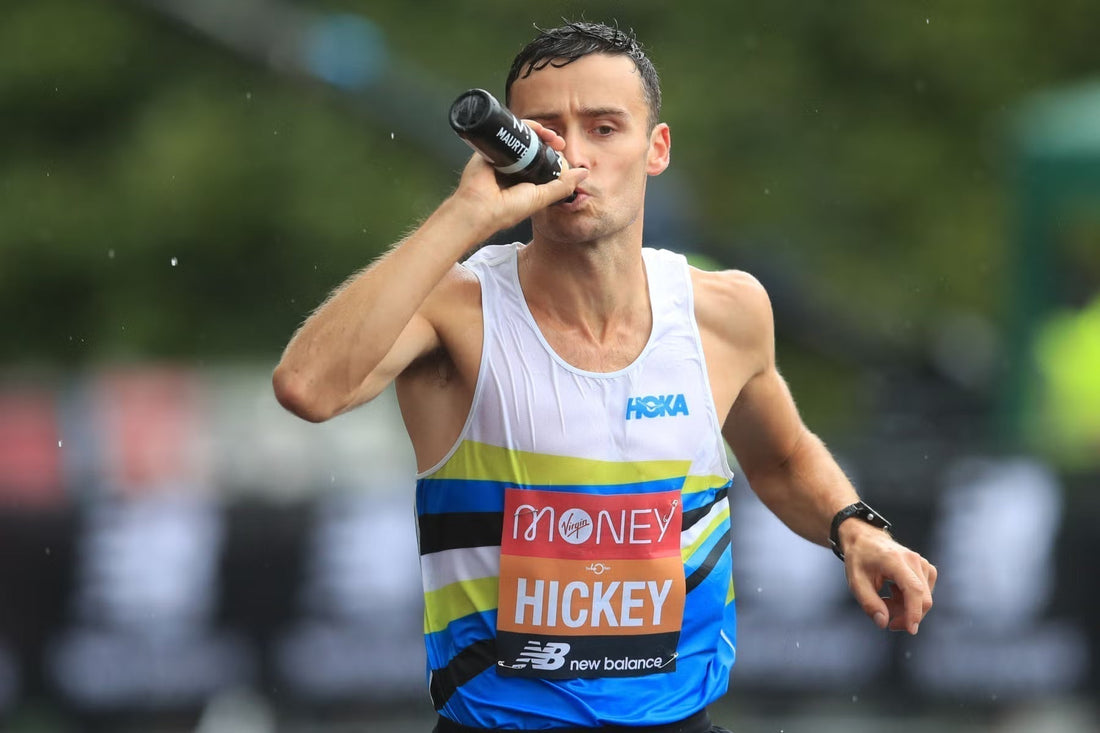
You run a 5 km on Tuesday and a 10 km on Saturday. You wonder if you need a sports drink on every run.
The answer depends mostly on the time you spend exercising, more than on the distance.
A fast runner on a 10 km and a runner taking their time on a 5 km don't have the same needs. Yet both are running a distance people call short.
The benchmarks in this guide come from the recommendations of the American College of Sports Medicine (ACSM).
Why distance alone is not enough
Distance on the ground is a poor indicator of your carbohydrate and sodium needs. What matters is how long you're out there, not the number on your bib.
Nutrition-wise, a 5 km in 20 minutes has almost nothing in common with a 5 km trail run in 35 minutes on hills. The same goes for a 10 km run in 40 minutes versus a slower 10 km training run in 75 minutes.
Two runners signed up for the same race won't get the same answer to the question "do I need a sports drink?".
Three factors change your needs, whatever the distance on the bib:
- The duration of your effort, meaning your pace over that distance
- The temperature and your sweat rate, which varies a lot from one person to another
- Intensity, because a hard effort burns through your glycogen stores faster than a moderate one
That's why this guide is built around blocks of effort duration rather than mileage. It helps you find your own category instead of applying one rule to everyone.
Key Takeaways
- Less than 60 minutes: water is generally enough.
- Between 60 and 150 minutes: 30 to 60 g of carbohydrates per hour.
- Over 150 minutes: up to 90 g of carbohydrates per hour, with 300 to 600 mg of sodium per hour.
These benchmarks come from ACSM recommendations on sports nutrition. Your sodium losses range from 300 to 1000 mg per hour depending on your sweat rate.
Your distance based on your pace, at a glance
| Distance | Typical duration | Need during effort |
|---|---|---|
| 5 km | 20 to 35 min | Water is enough in the vast majority of cases |
| 10 km | 35 to 75 min | Depends on your pace, pivotal zone |
| Half-marathon (21.1 km) | 1h30 to 2h30 | Carbohydrates and sodium recommended from the first hour |
| Triathlon | 1h to 10h depending on format | Segment plan, carbohydrates and sodium essential beyond the sprint |
The 5 km, a short run where a sports drink is rarely needed
If your 5 km takes less than 30 to 35 minutes, water does the job in the vast majority of cases. Your glycogen stores are enough for an effort of that length, whatever the intensity.
Three situations are exceptions:
- high heat
- high humidity
- heavy sweating, even on a short effort
In those cases, a small amount of electrolytes after the effort helps your recovery. During the race, it's not necessarily needed.
Our article on the 5 km covers the cases where it's worth it. You'll find a simple test to see if you're a heavy sweater, and where Maple MC2 fits even on a short run.

The 10 km, the grey zone where it starts to count
The 10 km is the pivotal distance. A fast runner, at 35 or 40 minutes, stays in the zone where water is enough.
Past 50 minutes on a 10 km, you enter the 60-minute window where carbohydrates become useful.
The ACSM guideline of 30 to 60 g of carbohydrates per hour applies as soon as your effort goes past one hour. Below that, focus on good hydration before the effort rather than a sports drink during it.
Two articles go further on this distance:
- Your threshold based on your pace: our 10 km article compares the options and offers a simple calculation.
- Brands side by side: our comparison for runners compares several hydration drinks in detail.
At the half-marathon (21.1 km), intake becomes strategic
The half-marathon typically lasts between 1h30 and 2h30 depending on your pace. You're right in the zone where the ACSM benchmarks apply:
- Carbohydrates: 30 to 60 g per hour
- Sodium: from the second hour, if your effort goes past 2 hours
At this distance, your choice of sports drink has a direct impact on your performance, on top of your comfort.
Your body weight also enters the calculation. Your absolute carbohydrate needs vary with your muscle mass and metabolism.
Our half-marathon article lays out an hour-by-hour intake plan, adjusted to your weight.
For the full marathon of 42.2 km, the needs scale up even further. Our comparison of the best drinks for marathon prep in Quebec covers that distance.
Triathlon, three disciplines and one intake plan
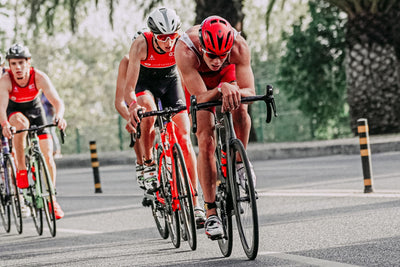
Triathlon complicates the equation because you switch disciplines during the effort. Each segment comes with its own constraints.
The total duration often runs from 1 to 10 hours depending on the format. On long formats, most triathletes land in this zone:
- 90 g of carbohydrates per hour
- 300 to 600 mg of sodium per hour
Two articles cover triathlon in more detail:
- Segment-by-segment plan: our triathlon article covers swimming, cycling and running.
- Choosing between brands: our comparison for triathletes compares the products.
How to adjust these benchmarks to your own body
The ACSM numbers are ranges. Three things make your needs vary within those ranges:
- your weight
- your metabolism
- your personal sweat rate
For sodium, the most reliable test is a simple one. Weigh yourself before and after a 30 to 60-minute run without drinking, or while noting exactly what you drink.
Each kilo lost equals about 1 litre of sweat. A loss of more than 1 to 1.5% of your body weight signals a high sweat rate.
In that case, aim for the top of the recommended range rather than the bottom.
Signs of dehydration to watch for during the effort

Thirst is still the first signal, but it often shows up once dehydration has already started. On longer distances, also watch for these signs:
- a persistent dry mouth, even after drinking
- headaches that come on during the effort, especially in the heat
- a loss of focus or slight confusion on very long distances
- dark urine in the hours after the effort, a sign of too little hydration before or during
On a 5 km or a 10 km, these signs are rare because the effort is too short for dehydration to set in. From the half-marathon up, they deserve your attention, especially in hot weather.
Packet, gel or tablet, which format to choose
The format matters almost as much as the content. Each one has a specific use:
- Packet: like Maple MC2, it dissolves in water and combines hydration, carbohydrates and sodium in a single serving. It suits distances where you drink regularly anyway.
- Gel: it delivers highly concentrated carbohydrates without dilution. It works as a supplement on long formats, to raise your carbohydrate intake without drinking more liquid.
- Effervescent tablet: it mainly provides electrolytes, without carbohydrates. It's aimed at heavy sweaters who want to manage their sodium separately from their energy intake.
For most regular runners, a diluted packet is the simplest choice. It handles hydration and intake in one step.
How Maple MC2 fits into each block

Each Maple MC2 packet, made from Quebec maple syrup, provides:
- 110 kcal
- 28 g of carbohydrates
- 414 mg of electrolytes, including 273 mg of sodium, 94 mg of potassium and 47 mg of calcium
On a 5 km or a fast 10 km, a packet after the effort helps with recovery. You don't need one during the race.
On a half-marathon or a triathlon, several packets spread out during the effort cover part of the carbohydrate and sodium needs recommended by the ACSM.
Adjust based on your weight and sweat rate. Add a gel or a more concentrated product if you're aiming for the top of the range on a long format.
On long distances, keep a personalized sports nutrition plan and build Maple MC2 into it. It's a natural option, with no artificial sugars, that covers part of your needs whatever your training distance.
The same product takes you from a 5 km to an Ironman, only the quantity changes. You can see the full range designed for runners in our sports drink for runners collection.
Common myths about hydration while running
- "The more you drink, the better". It's false, and potentially dangerous on long distances. Drinking more than you lose in sweat dilutes the sodium in your blood, a risk in marathons and Ironman races.
- "Cramps come from a lack of electrolytes". A good share of current research points instead to local neuromuscular fatigue. An electrolyte drink helps you stay hydrated, without guaranteeing you won't cramp.
- "You have to drink before you're thirsty". This advice, popular in the 1990s and 2000s, is more nuanced today. For efforts under 90 minutes, drinking to thirst is a valid strategy for most runners.
- "A sweeter drink gives more energy". A carbohydrate concentration that's too high slows gastric emptying and can cause discomfort, without speeding up absorption. Concentration matters as much as the total amount.

Frequently asked questions