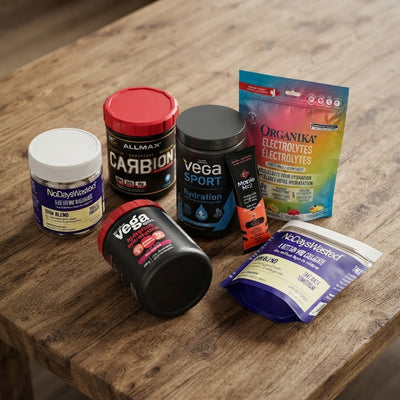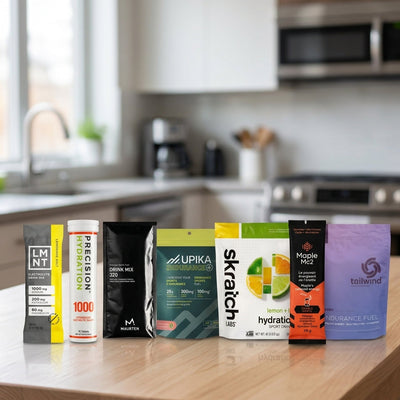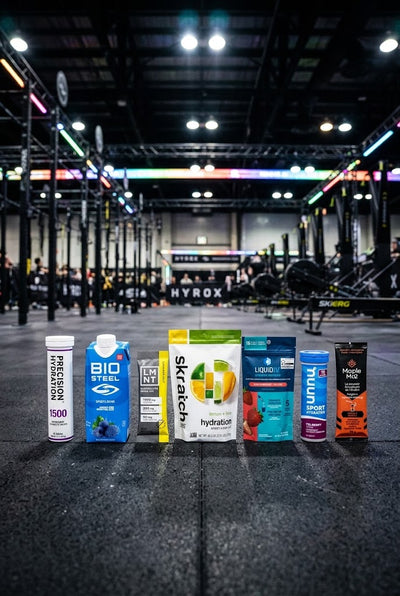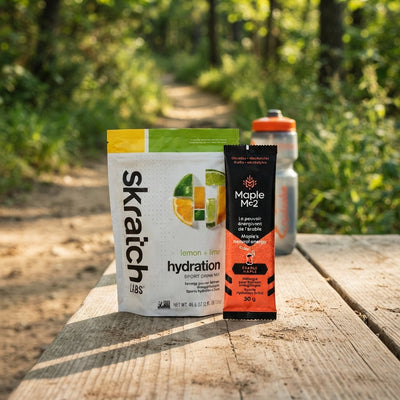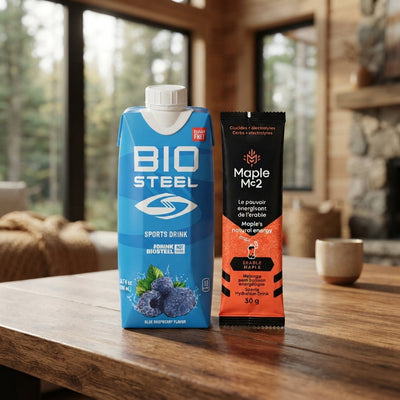
You type "best runner hydration drink" into Google and you find products designed for running 100 km in the mountains or completing a marathon in 2h30.
If your reality is three to five runs a week between 5 and 21 km, these products might not be for you.
Not because they're bad.
But because they address a different problem.
We compare five options that serious runners actually use:
- Näak
- Tailwind Nutrition
- Precision Hydration
- Maurten
- Maple MC2
We'll honestly tell you who each one is for, without claiming that a single drink suits everyone.
Amateur runners don't have the same needs as ultra or elite runners
Most technical recovery drinks on the market were developed for ultra-trail running or high-level racing.
This is no coincidence: it's where brands compete, and it's this audience that most intensely tests the formulas.
The problem is that these products bring their logic to the shelves aimed at the Sunday runner.
A drink designed to sustain 6 hours of effort in the mountains, with 80g of carbohydrates per serving or an adjustable sodium dose up to 1000mg, has no reason to be used on a 45-minute weekday run.
Your digestive system doesn't need that volume, and neither does your wallet.
If you're looking for the basics (how much to drink, how often, when), we've written a complete guide on that: how a runner should hydrate during training.
This article is a product comparison, not an instruction manual. And if you cycle more than you run, our comparison for cyclists addresses similar questions for a different type of effort.
Our comparison criteria
We compared the five options on four concrete points, not marketing criteria:
- Sodium and electrolytes per serving, because these prevent cramps and fatigue related to dehydration
- Carbohydrates per serving, because a 45-minute run and a 4-hour run don't have the same energy needs
- The ingredient list, because a product dosed for ultra-distance often contains additives designed for that reality (synthetic flavors, thickening agents, caffeine) that are unnecessary for a short run
- Price per serving for regular use, because a runner who trains 4 times a week doesn't consume a drink like a competitor who uses it 5 times a year in races
A fifth criterion, less visible but just as real: realistic frequency of use. A product can be excellent on paper and yet stay in the cupboard because it's too expensive to drink with every training session, or because the taste becomes tiresome after the tenth time.
We haven't tested these five products in a laboratory, and we don't have a scientific team dedicated to sports nutrition.
This comparison is based on the public product sheets of each brand, with a cited source for each figure. Where data was not clearly confirmed in Canadian dollars, we stated that rather than inventing a figure to fill the gap.
1. Maple MC2 - Best for regular training, from 5K to marathon

Maple MC2 - Maple
$2.79/sachet, $29.99 per box of 12
For whom: The runner who trains several times a week and wants a drink they can consume with every run, without it being a specialist product or a competitor's expense.
- 28g of carbohydrates and 414mg of electrolytes per sachet (273mg sodium, 94mg potassium, 47mg calcium). The sachet also contains 15mg of magnesium, which is not included in this 414mg total.
- Maple syrup as the sole source of carbohydrates, rather than a blend of maltodextrin, dextrose, and synthetic flavors
- Certified organic maple syrup; the finished drink itself is not, because the added salt and natural flavors are not covered by this certification
- Made at Ferme St-Ours, in Montérégie
Points to consider: This dosage is calibrated for 45 to 90 minutes of moderate effort. For a multi-hour run, a more carbohydrate-concentrated formula better meets energy needs.
2. Näak Ultra Energy - Best for ultra-trail and multi-hour runs

Näak Ultra Energy Drink Mix
Price per serving not uniformly confirmed in Canadian dollars according to retailers consulted
For whom: The runner preparing for an ultra-trail or a multi-hour run, where the body burns reserves that a 45-minute run doesn't even touch.
- 250 kcal, 57g carbohydrates and 650mg electrolytes advertised per 500ml serving, plus 1000mg BCAAs
- Sugar blend (dextrose, maltodextrin, isomaltulose), isolated canola protein, sea salt, potassium citrate
Points to consider: For regular 5K to half-marathon training, this is significantly more carbohydrates and functional ingredients (including BCAAs) than most runners will use at this intensity and duration.
3. Tailwind Endurance Fuel - Best for long endurance runs

Tailwind Nutrition Endurance Fuel
$4.25 CAD per unit; up to approximately $0.88 CAD/serving in a 50-serving bag
For whom: The runner already preparing for ultra-distance or a very long weekly run, where a simple and well-tolerated formula over several hours makes a difference.
- 310mg sodium per serving, formula designed to be diluted in a large volume of water for long efforts
- A benchmark among ultramarathoners and long-distance cyclists
Points to consider: For a 45 to 90-minute run, the sodium dose significantly exceeds what an effort of this duration loses in sweat.
4. Precision Hydration PH 1000 - Best for heavy sweaters and extreme heat

Precision Hydration PH 1000
Price per serving not uniformly confirmed in Canadian dollars according to retailers consulted
For whom: The runner who sweats a lot and trains in extreme heat, with a real need to replace a large amount of sodium.
- 500mg sodium, 260mg potassium, 40mg calcium, and 20mg magnesium per 473ml (16oz) serving, for only 10 kcal and 3g carbohydrates
- Multiple sodium concentrations offered (500 to 1500mg per liter) to adjust according to personal sweat rate
Points to consider: This is a pure electrolyte product, without significant energy input. Useful for a specific sodium need in high heat, less relevant as a standard training drink for the rest of the year.
5. Maurten Drink Mix 320 - Best for competitive racing and elite marathon

Maurten Drink Mix 320
$3.50 to $5.35 CAD per sachet depending on retailer; approximately $5.07 CAD per box of 14
For whom: The runner preparing for a specific race, where the goal is to maximize available energy over a fixed and pre-known duration.
- 80g carbohydrates and 160mg sodium per 500ml serving, thanks to an encapsulation technology (hydrogel) that allows for absorbing a very high carbohydrate load without the bloating it would normally cause
- This is the drink seen in the hands of elite marathon runners
Points to consider: 80g of carbohydrates per serving is almost triple that of a Maple MC2 sachet. On a training run, where the goal is to progress without upsetting your stomach, this carbohydrate load is generally more than necessary.
Comparative table
| Brand | Format | Sodium/serving | Carbohydrates/serving | Designed for |
|---|---|---|---|---|
| Maple MC2 | 30g sachet in 500ml | 273 mg | 28 g | Regular training, 5K to half-marathon |
| Näak Ultra Energy | Sachet in 500ml | 650 mg total electrolytes announced | 57 g | Ultra-trail, multi-hour runs |
| Tailwind Endurance Fuel | Portion diluted in large volume | 310 mg | Not uniformly communicated depending on format | Ultra-endurance, long runs |
| Precision Hydration PH 1000 | Sachet/tablet in 473 ml | 500 mg | 3 g | Heavy sweaters, extreme heat |
| Maurten Drink Mix 320 | Sachet in 500 ml | 160 mg | 80 g | Competition, elite marathon |
How to choose based on your run
For a short run, 5K to 10K, under an hour: water alone is often enough.
If you still want a drink (heat, heavy sweating, late-day training without having adequately hydrated beforehand), a moderate formula like Maple MC2 covers the need without excess.
For a medium run, 10K to half-marathon, 60 to 120 minutes: this is the zone where a drink combining carbohydrates and electrolytes in a reasonable dose makes a real difference, without needing to aim for the 60 to 90g of carbohydrates per hour recommended for prolonged endurance efforts.
For a weekly long run beyond 2 hours, or preparation for a marathon or ultra: this is where products like Tailwind, Näak, or Maurten become relevant, because the duration of the effort justifies their higher concentration.
Moreover, there's nothing preventing combining: Maple MC2 for regular training runs, a more concentrated product reserved for specific long runs.
There's nothing rigid about this breakdown. The weather changes the game: a 10K run in 30-degree weather makes you lose more sodium than a 15K run in cool weather.
The right approach is to consider duration and heat together, not just the distance on your watch.
How often to drink it during training

A hydration drink doesn't need to be reserved for special outings. For a runner who trains three to five times a week, using it on every run longer than 30 to 40 minutes, or whenever heat or humidity are high, is reasonable.
On a very short run or in a cool environment, water alone works perfectly well.
It's also a matter of budget and habit.
A sachet with each run costs more than occasionally, but remains simpler to integrate into a routine than a product reserved for rare long runs that ends up being forgotten in a drawer.
Our collection for runners includes all three flavors and the discovery box, useful for testing what works best during effort.
Do you mix running and CrossFit? We also compared the electrolyte drinks for CrossFit, where the needs and the brands are different.
Common hydration mistakes for a regular runner
Using a drink designed for ultra-distances on a 45-minute run. The carbohydrate surplus is useless for that duration of effort and can even cause unnecessary digestive discomfort.
Waiting until you're thirsty to start drinking on a run longer than an hour in high heat. The sensation of thirst comes after dehydration has begun, not before.
Changing drinks just before a race or an important test. The body tolerates a familiar formula better. This is true for any of the five options in this article, including Maple MC2.
Confusing training hydration with race fueling. What you drink three times a week in training doesn't have to be the same as what you drink on race day.
Frequently Asked Questions
In summary
On one side, highly concentrated formulas designed for ultra-distance or competition. On the other, a drink dosed for regular training. For your regular runs from 5K to half-marathon, Maple MC2 remains our choice: maple syrup does most of the work, without the excess carbohydrates or sodium that your body doesn't need on a 45 to 90-minute run.
Discover the Maple flavor; See all Maple MC2 drinks