"Hydrate. Eat a banana. Stretch."
Type "how to prevent muscle cramps during exercise" into Google, and you'll see this phrase 9/9 times, across nine different websites.
- None cite a study
- None tell you how much sodium or potassium you actually lose during exercise
- None explain why the link between dehydration and cramps is still debated among researchers
Here's what research actually says about muscle cramps during exercise, with a quantitative guide to electrolytes so you know what you really need to replace.
Why You Get Muscle Cramps During Exercise

The short answer: researchers don't fully agree yet.
Two hypotheses coexist:
- Electrolyte imbalance. You lose sodium and potassium in your sweat, and this deficit promotes cramping.
- Neuromuscular fatigue. After prolonged or too intense exertion, the muscle loses control of its own contraction, regardless of your hydration level.
A review published in Sports Health presents these two mechanisms as complementary, not contradictory.
A study published in Muscle & Nerve points to neuromuscular fatigue as a key factor, especially in athletes who increase their training volume too quickly.
In concrete terms: your hydration matters, but it's not the only variable.
Hydration Before, During, After Exercise: The "How Much" No One Tells You

Drinking water is fundamental. But water alone doesn't replace the electrolytes you lose.
A study published in the Journal of Athletic Training showed that electrolyte supplementation delays the onset of cramps in athletes training in the heat.
Another study published in the British Journal of Sports Medicine linked a decrease in serum sodium to an increased prevalence of cramps.
And a study comparing a rehydration solution to spring water found that the electrolyte solution reduces susceptibility to cramps.
Before Exercise
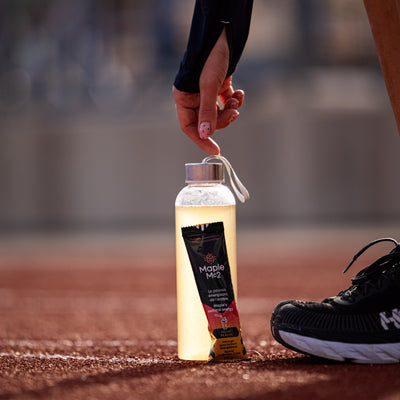
One sachet in 500 ml of water, one to two hours before starting.
During Exercise: How Much to Drink to Prevent Muscle Cramps
Beyond 60 minutes, plan for electrolyte intake every 45 to 60 minutes. Not just water.
After Exercise
Within 30 to 60 minutes after finishing, to replace what sweat has carried away.
Key takeaway
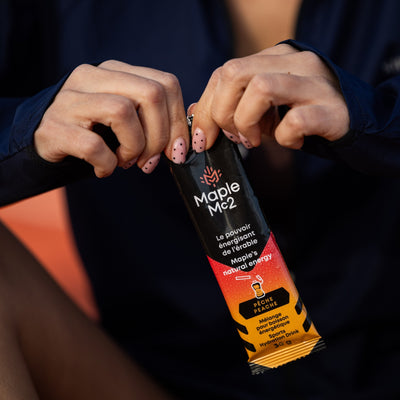
One Maple MC2 sachet contains 273 mg of sodium, 94 mg of potassium, and 47 mg of calcium. Water alone: 0 mg of all three. That's the difference between replacing and just diluting.
| Electrolyte | Water alone | Maple MC2 Sachet |
|---|---|---|
| Sodium | 0 mg | 273 mg |
| Potassium | 0 mg | 94 mg |
| Calcium | 0 mg | 47 mg |
| Total electrolytes | 0 mg | 414 mg |
Discover the full profile of the maple drink.
Nutrition and Minerals: Magnesium, Potassium, Calcium

The usual sources always come up: banana, almond, sweet potato, dark chocolate.
These are good sources of magnesium and potassium. But they act on your general mineral status, not on what you lose during a 90-minute outing in direct sun.
A study on long-distance runners published in the British Journal of Sports Medicine even qualifies the direct link between serum electrolytes and cramps. The mechanism is real, but it is not yet reliably measurable on an individual basis.
What we do know, however: organic maple syrup produced in Saint-Ours provides 28g of carbohydrates and 110 kcal per sachet, with its natural minerals, without chemical transformation.
Discover our origin in Saint-Ours, in Montérégie.
A numbered benchmark, not just generic advice
273 mg sodium, 94 mg potassium, 47 mg calcium per sachet.
Discover the Maple drinkWarm-up, Stretching, and Muscle Preparation

A cold muscle tires faster. And neuromuscular fatigue, as we saw above, is part of the cramping mechanism.
Before exercise:
- Dynamic stretching, not static. Controlled movements, no holding positions for long.
- 5 to 10 minutes of progressive intensity before tackling your running or cycling pace.
- A gradual increase in load from week to week, not a sudden jump in volume.
Static stretching, however, has its place after exercise. Not before.
How to Prevent Cramps During Exercise: What to Do If It Happens Anyway

Even with the best preparation, a cramp can happen.
Here's what to do:
- Stop. Continuing with a cramp will worsen the contraction.
- Gently stretch the affected muscle, without forcing.
- Breathe slowly. Nervous tension amplifies muscle contraction.
- Hydrate immediately, with electrolytes if you have them.
- Resume gradually. No immediate sprinting after a calf cramp.
If cramps return every time you exercise, it's probably your training volume or preparation that needs adjusting, not just your water bottle.
Frequently Asked Questions
In Summary
On one side: "hydrate and eat a banana," repeated on nine sites without a single supporting study.
On the other: two identified research mechanisms, a quantitative guide to electrolytes, and muscle preparation that matters as much as the water bottle.
Avoiding muscle cramps during exercise is not a magic formula. It's about structured hydration, real quantity mineral replacement, and a warm-up taken seriously.
Discover the Maple drink or explore our maple drinks.