You exit the water, slip on your cycling shoes, and run toward transition. Two bottles are fixed to your frame, and you still have 40 kilometers to go before you put on your running shoes.
In those bottles, you have one of three things:
- water, because that's what was at home
- a sports drink bought at the last minute
- an electrolyte powder recommended by a club friend, for which you don't really know the dosage
A triathlon is three sports in one, lasting anywhere from a little over an hour to more than ten hours. Your drink cannot be the same for a sprint as it is for an Ironman.
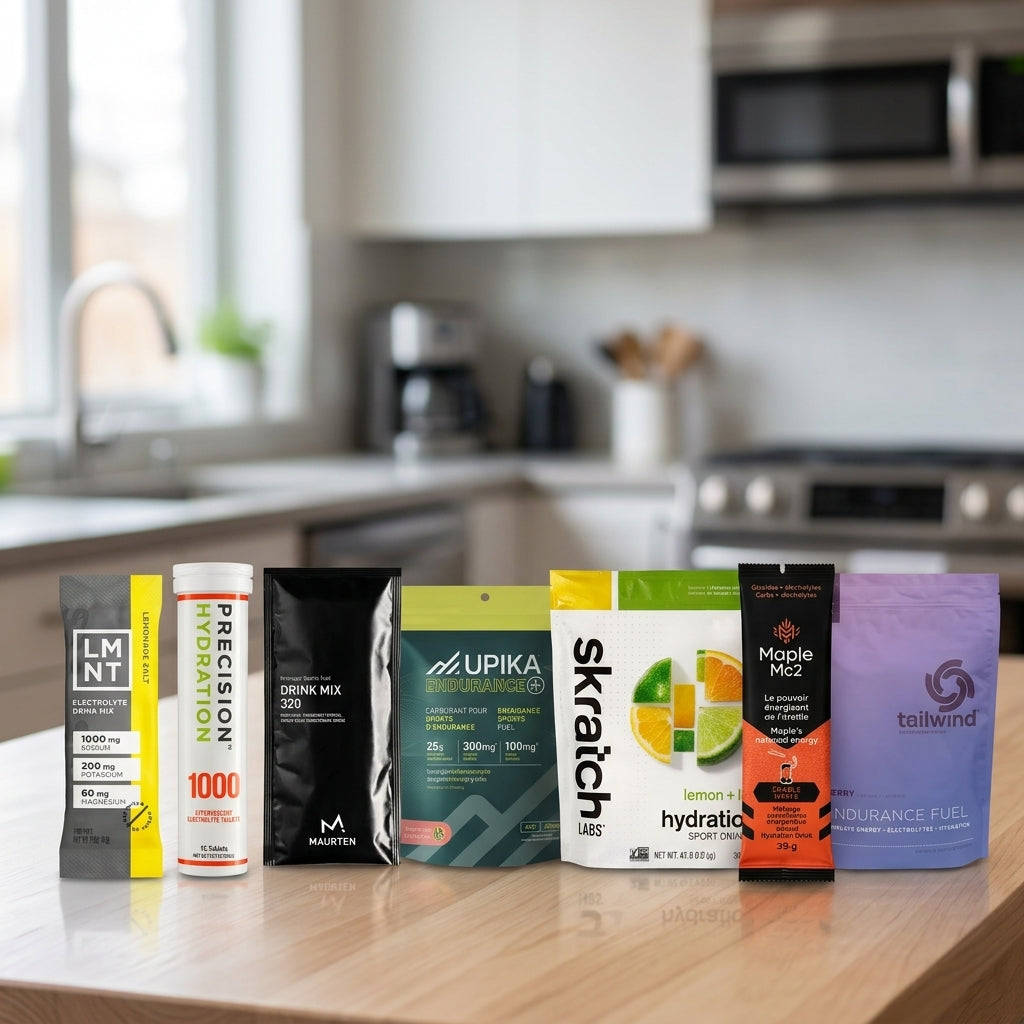
We compared seven products, including our own, according to criteria we explain below. Here is our ranking of the best electrolyte drinks for triathletes, along with the flaws of each.
What your drink needs to do in a triathlon
The distances change everything. Here are the four most common formats:
- Sprint: 750 m swim, 20 km bike, 5 km run
- Olympic: 1.5 km swim, 40 km bike, 10 km run
- 70.3: 1.9 km swim, 90 km bike, 21.1 km run
- Ironman: 3.8 km swim, 180 km bike, 42.2 km run
You don't drink in the water. The bike is where you drink the most, because you have bottles and a steady rhythm. Running is where the stomach protests, because everything is jostling you.
A good electrolyte drink for triathletes must therefore check four boxes:
- provide sodium and carbohydrates in the same bottle, at a dosage you know
- sit well during the bike, then during the run immediately after
- be easy to carry, in a bottle or a jersey pocket
- cost a price that allows you to drink it at every session
Key takeaway
A single type of carbohydrate can be oxidized up to about 60 g per hour, which is the recommendation for an effort of two to three hours. For ultra-endurance, you move toward 90 g per hour, using several types of carbohydrates at once, according to Jeukendrup (2014).
To organize your hydration during exercise, also read our article on how to hydrate for running.
Our comparison criteria
We looked at seven products sold in Canada, based on six criteria:
- Sodium per serving, because that's the number everyone talks about
- Carbohydrates per serving, because that's what allows you to keep going for three hours on the bike
- Ingredient list, to know what's in the sachet besides salt
- Price per serving, calculated from the price listed by the brand or retailer
- Format, for a bottle as well as a jersey pocket
- Digestive tolerance, to the extent that we can judge based on the ingredients (we didn't perform laboratory tests)
A word on transparency: Maple MC2 is our product, and it is part of our collection for triathletes and swimmers. We placed it first because our ranking rewards the real-world usage of a triathlete training year-round, not because it wins on every criterion.
It doesn't win on carbohydrates per serving or on sodium, and we state that in its product sheet as well as in the table. For long distances, other products here perform better.
Each figure comes from the manufacturer's sheet, a cited retailer, or a public database. When a price was not confirmed in Canadian dollars, we did not list it.
The 7 best electrolyte drinks for triathletes
#1 Maple MC2 Maple: the most versatile for training

Maple MC2 Maple
$2.79 per sachet, $2.50 in a box of 12 ($29.99), $23.99 with subscription
For whom: the triathlete who trains often, runs sprints and Olympic distances, and wants a natural drink that they will drink at every session.
- 414 mg of electrolytes per 30 g sachet: sodium 273 mg, potassium 94 mg, calcium 47 mg. Magnesium (15 mg) is added; it is not counted in this total.
- 28 g of carbohydrates and 110 kcal, which come from maple syrup, with no added amino acids or vitamins.
- Certified organic maple syrup. The finished drink is not, because the salt and natural flavors are not covered by this certification.
- Gluten-free, vegan, no artificial colors or sweeteners. Made at the Ferme St-Ours, in Montérégie.
To consider: for a 70.3 or an Ironman, 28 g of carbohydrates per sachet requires taking two per hour to approach 60 g, which costs about $5 an hour and takes up space in the bag. And 273 mg of sodium is not enough for a heavy sweater.
Why the top spot? Because most triathletes spend more time training than running Ironmans. For one to two-hour bike and run sessions, a sachet with carbohydrates and sodium, in a flavor you actually want to drink, does the job.
For long distances, we are honest: other products in this ranking are more suitable.
#2 Tailwind Endurance Fuel: everything in one bottle

Tailwind Endurance Fuel
Price varies by retailer
For whom: the long-distance triathlete who wants everything in one bottle: carbohydrates and electrolytes.
- 100 kcal, 25 g of carbohydrates, 303 mg of sodium and 88 mg of potassium per 27 g scoop
- Carbohydrates from dextrose and sucrose, so several different sugars
- Multiple flavors, including an unflavored version
To consider: these are added sugars, and the sodium remains average if you sweat a lot. At one scoop per bottle, you have to calculate your carbohydrates per hour.
#3 Maurten Drink Mix 160: the most carbohydrates per serving

Maurten Drink Mix 160
$58 CAD for a box of 18 at Canadian retailers, or about $3.22 per serving
For whom: someone who wants a lot of carbohydrates per serving and who is willing to pay more for a highly studied formula.
- 40 g of carbohydrates per sachet diluted in 500 ml of water, for about 160 kcal
- Maltodextrin and fructose, with sodium alginate and pectin that form a hydrogel in the stomach, salt and sodium bicarbonate
- No colorings
To consider: it is the most expensive product in the ranking per serving. Sodium is not its strong point, and the gel-like texture is not to everyone's liking.
#4 Skratch Labs: cane sugar and average sodium

Skratch Labs Hydration Sport Drink Mix
Price varies by retailer
For whom: someone who prefers cane sugar carbohydrates and a simple drink, with average sodium.
- 400 mg of sodium and about 20 g of carbohydrates per serving, for about 80 kcal
- Carbohydrates from cane sugar and dextrose, with sodium citrate, potassium citrate, magnesium lactate and calcium citrate
- Multiple fruit flavors
To consider: with about 20 g of carbohydrates per serving, you will drink several per hour if you are aiming for long distances. The carbohydrates are added sugars.
#5 Upika Endurance: the Quebec choice for endurance

Upika Endurance
Price varies by retailer
For whom: someone who wants a Quebec product designed for endurance, with carbohydrates and sodium.
- 25 g of carbohydrates, 300 mg of sodium and 1 g of taurine per 29 g serving, with potassium, magnesium, calcium and vitamins B6 and C
- 16 g of cyclic dextrin, a carbohydrate that empties quickly from the stomach
- Designed and manufactured in Quebec. The Endurance+ version adds 100 mg of caffeine per serving
To consider: taurine, and the caffeine in the Endurance+ version, are not suitable for everyone. And as with the others, the price changes from one retailer to another.
#6 Precision Hydration PH 1500: for heavy sweaters

Precision Hydration PH 1500
Price varies by retailer
For whom: the heavy sweater, or someone who wants to choose the sodium concentration of their drink.
- 1,500 mg of sodium per liter once diluted according to the manufacturer's instructions. The brand also sells a PH 1000 version, which is less concentrated.
- Powder in individual waterproof sachets
- Gluten-free and vegan, with few calories
- British brand, designated in 2024 as the official electrolyte drink for all Ironman races in Europe
To consider: the concentration is high, so the taste is strong. No carbohydrates to count here: you will have to find them elsewhere. Price and availability vary by Canadian retailer.
#7 LMNT: sodium without sugar

LMNT Recharge
$1.50 US per stick in a box of 30 ($45 US)
For whom: the very heavy sweater, or someone who has already had their sweat measured and wants sodium without sugar.
- 1,000 mg of sodium, 200 mg of potassium and 60 mg of magnesium per stick
- Sugar-free formula
- Multiple salty flavors
To consider: zero carbohydrates means zero energy: you must provide them with a gel or a drink on the side. The price is in US dollars, and the very salty taste is not to everyone's liking.
We wrote a more detailed comparison: which natural alternative to LMNT to choose in Canada.
Try all three flavors
Maple, Maple-Blueberry, Maple-Peach. 12 sachets to find the one that goes down best on the bike.
Discovery Box | $29.99Comparison table of electrolyte drinks for triathletes
| Brand | Sodium per serving | Carbs per serving | Calories | Approx. price per serving | Format |
|---|---|---|---|---|---|
| Maple MC2 Maple | 273 mg | 28 g | 110 | $2.50 to $2.79 | 30 g sachet |
| Tailwind Endurance Fuel | 303 mg | 25 g | 100 | Varies by retailer | Powder (27 g scoop) |
| Maurten Drink Mix 160 | Not highlighted | 40 g | Approx. 160 | Approx. $3.22 | 42 g sachet |
| Skratch Labs | 400 mg | Approx. 20 g | Approx. 80 | Varies by retailer | Powder |
| Upika Endurance | 300 mg | 25 g | Not specified | Varies by retailer | Powder (29 g serving) |
| Precision Hydration PH 1500 | 1,500 mg per liter | Low | Low | Varies by retailer | Sachet or tablet |
| LMNT | 1,000 mg | 0 g | Not specified | $1.50 US | Stick |
How to choose based on your distance
There is no single right answer. Here is how we sort it:
- Sprint, Olympic, and daily training: Maple MC2, Skratch Labs, or Upika Endurance
- 70.3 and Ironman, when you are aiming for many carbohydrates per hour: Tailwind or Maurten
- You sweat a lot, or you run in the heat: PH 1500 or LMNT, with carbohydrates on the side
- You want a Quebec product: Maple MC2 or Upika Endurance
- You want zero sugar in the bottle: PH 1500 or LMNT
Nothing stops you from combining them. Many triathletes put carbohydrates in one bottle and sodium in another, or take a sodium-rich product before a long ride.
Do you ride a bike mostly? Our guide on the best sports drinks for cyclists goes further. Are you preparing for a marathon after a half-Ironman? Read the 7 best drinks for marathon prep in Quebec.
Carbohydrates and sodium per hour: do the math
The question isn't just "which drink." It's also "how much per hour."
Take Maple MC2: one sachet provides 28 g of carbohydrates and 273 mg of sodium. Two sachets per hour is 56 g of carbohydrates and 546 mg of sodium, for about $5 an hour. That approaches the 60 g zone, but it comes at a cost and takes up space.
With Tailwind, two scoops provide 50 g of carbohydrates and 606 mg of sodium. With Maurten, one sachet already provides 40 g.
The right number depends on your weight, your intensity, and what your stomach can handle. It should be tested in training, not on the starting line.
To learn more about what maple syrup does during exercise, read what science says about maple syrup in sports nutrition.
How to use your electrolyte drink in a triathlon
Before the race
Some athletes take one serving in 500 ml of water, 30 to 45 minutes before the start. Test it during a normal session, never for the first time on race day.
During the race

The bike is your main moment. Drink in small, regular sips, rather than one large glass all at once.
When running, your stomach is more fragile. Eat and drink what you have already tested; nothing new.
After the race
After a long effort, the goal is to start drinking and eating normally again. Our post-exercise recovery collection and the article what to drink after a workout go further.
Frequently asked questions
In summary
On one side, products very high in carbohydrates for long distances. On the other, a drink designed for regular training.
For most triathletes, the best electrolyte drink is the one you will actually drink during every session, that you like the taste of, and that your stomach tolerates, at a price that makes sense. For training and short formats, it's Maple MC2. For a 70.3 or an Ironman, Tailwind or Maurten are better for carbohydrates.
Discover the Maple flavor ; Discovery Box ; See the triathlete and swimmer collection