Short answer
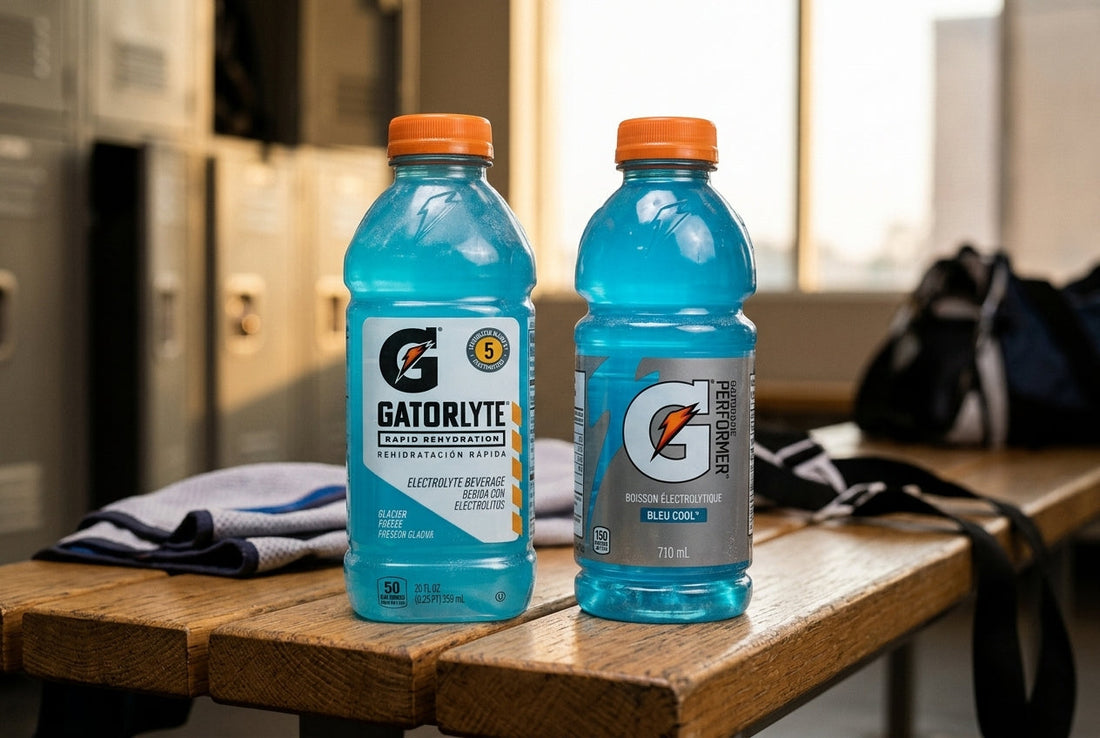
Gatorlyte contains about 83 mg of sodium per 100 mL, compared to 45 mg for Gatorade, and about 2 g of sugar per 100 mL, compared to 5.9 g. It is a drink for heavy sweating, not fuel for a long workout. A 591 mL bottle provides around 14 g of carbohydrates, far from the 30 to 60 g per hour recommended after an hour of exercise.
You saw the bottle at the convenience store. The label says "fast rehydration".
It looks like a Gatorade, with an orange or cherry-lime flavor, but it costs a little more and the sodium number jumps out at you.
So you wonder what changes, and if it is worth it for your next outing.
We read the Canadian retailer sheets and the box label of the powder. The Gatorlyte vs Gatorade comparison is done figure by figure.
Gatorlyte vs Gatorade, the side-by-side table
A bottle of Gatorlyte is 591 mL, a Gatorade 355 mL and a Powerade 710 mL. To compare without making mistakes, we bring everything to 100 mL. The Maple MC2 packet is calculated diluted in 500 mL of water.
| Per 100 mL | Gatorlyte | Gatorade Thirst Quencher | Powerade | Maple MC2 |
|---|---|---|---|---|
| Sodium | 83 mg | 45 mg | 68 mg | 55 mg |
| Potassium | 59 mg | 13 mg | 21 mg | 19 mg |
| Sugars | 2.0 g | 5.9 g | 5.8 g | 2.8 g |
| Calories | 8 to 10 kcal | 23 kcal | 23 kcal | 22 kcal |
| Reference format | 591 mL bottle | 355 mL bottle | 710 mL bottle | 30 g packet in 500 mL |
The Gatorlyte values come from the sheets of Real Canadian Superstore and Voilà for the Orange, Strawberry-kiwi and Cherry-lime flavors. Those of Gatorade and Powerade are the same as in our article Gatorade vs Powerade.
The sheets give 50 calories per bottle, and the Gatorade Canada page shows 60. The difference explains the range of 8 to 10 kcal per 100 mL.
To remember
- Gatorlyte has almost twice as much sodium as Gatorade per 100 mL.
- It has three times less sugar, so less energy.
- Maple MC2 is between the two on sodium, with sugar that comes from maple syrup.
What is in a bottle of Gatorlyte
Gatorlyte presents itself as a mixture of five electrolytes. The Canadian sheets indicate the following values for a 591 mL bottle.
| Nutrient | Per 591 mL bottle |
|---|---|
| Sodium | 490 mg |
| Potassium | 350 mg |
| Calcium | 125 mg |
| Magnesium | 105 to 120 mg depending on the sheet |
| Carbohydrates | 14 g, including 12 g of sugars |
| Calories | 50 to 60 kcal |
The magnesium changes from one sheet to another, between 105 and 120 mg. The numbers of sodium, potassium and sugars match everywhere.

The ingredients of the bottle
The Orange flavor sheet lists the following ingredients.
- Water, sugar, citric acid and salt
- Calcium lactate, potassium chloride and magnesium oxide
- Stevia extract and natural flavor
- Sucrose acetate-isobutyrate and ester gum, two stabilizers
- Sunset Yellow FCF, a coloring
The list is longer than that of a maple packet. It contains added sugar and stevia in the same drink, which explains the very sweet taste despite only 12 g of sugars.
The coloring depends on the flavor. On the Google search page, the AI preview sometimes says "no artificial colors". The Orange flavor sheet however lists a coloring, so read the label of your bottle.
The powder version
Gatorlyte also exists in a box of six 15 g sticks, with the mention "Hydrates faster than water" on the box. One stick provides 45 calories, 10 g of carbohydrates including 9 g of added sugars, 420 mg of sodium, 300 mg of potassium, 95 mg of magnesium, 100 mg of calcium and 640 mg of chloride.
The powder ingredient list starts with sugar, citric acid and salt, then monopotassium phosphate, calcium lactate, magnesium oxide, maltodextrin and stevia extract. The box displays "no added colors or artificial sweeteners".
This label is that of a box sold in store, and it does not say where the powder is located in Canada. Check availability before looking for it.
And Gatorlyte Zero?
Gatorlyte Zero is sold without sugar. An American sheet of the Fruit Punch flavor lists water, citric acid, salt, natural flavor, calcium lactate, potassium chloride, magnesium oxide and stevia extract.
The list is shorter than that of the standard bottle, without added sugar. It provides no energy, so it is suitable for a session where you only want to replace salt. We did not find a complete Canadian sheet for this version, so read the label before comparing.
Gatorlyte vs Gatorade, what changes between the two
Three differences explain the essential of the gap.
- Sodium. Gatorlyte contains about 83 mg per 100 mL, compared to 45 mg for Gatorade. A 591 mL bottle provides 490 mg, a little more than three times what a 355 mL Gatorade bottle provides (about 160 mg).
- Sugar. Gatorlyte contains about 2 g of sugars per 100 mL, compared to 5.9 g for Gatorade. A full bottle provides 12 g of sugars, compared to 21 g in a 355 mL Gatorade.
- Intended use. Gatorade Canada ranks Gatorlyte among its drinks for intense activity. Gatorade Thirst Quencher aims for energy during exercise.
In short, Gatorlyte replaces the salt you lose with sweat, and Gatorade gives you sugar. Neither of them does both jobs at the same time.
Potassium follows the same logic, at 59 mg per 100 mL for Gatorlyte compared to 13 mg for Gatorade. For most athletes, it is sodium that counts the most, because it is the electrolyte we lose in the largest quantity in sweat.
To better understand why sodium and carbohydrates go together, read our article on the SGLT1 mechanism.
Gatorlyte and rehydration, is it the equivalent of a Pedialyte?

Gatorlyte approaches a rehydration drink with its high sodium and reduced sugar. It remains a sports drink sold for sweat, not an oral rehydration solution for illness.
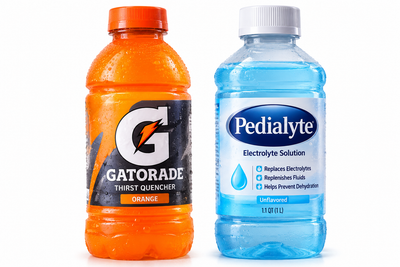
The two products do not have the same purpose. Pedialyte is designed to replace liquids lost by vomiting or diarrhea, and Gatorlyte to compensate for perspiration.
If you wonder which one to choose in case of a stomach flu, our article Pedialyte vs Gatorade details what research says. Neither Gatorlyte nor Gatorade replaces medical advice, especially for a child.
For what effort and what sweating
The amount of sodium lost by sweat changes a lot from one person to another. A review published in Sports Medicine describes it well, showing that two athletes who do the same effort do not lose the same thing.
The right choice depends on your situation.
- Short session of less than 45 minutes. Water is enough most of the time. Gatorlyte provides nothing more.
- One-hour effort, normal temperature. Gatorlyte can help if you sweat a lot, with its 490 mg of sodium per bottle. If you sweat little, you do not need it.
- Heat or sweat that leaves white traces on clothes. This is the use case targeted by Gatorlyte, with its higher sodium.
- Effort of more than an hour and a half. You need to add a source of carbohydrates, because the bottle only provides 14 g.
Digestion and tolerance
The bottle contains citric acid, sugar, stevia and magnesium oxide, which can bother some stomachs during exercise.
Each stomach reacts in its own way. Test your drink at training, never for the first time on race day.
The limits of Gatorlyte for a long effort

Gatorlyte was designed to replace salt, not to feed the effort. A 591 mL bottle contains about 14 g of carbohydrates.
For an intense effort of more than an hour, the position of the American College of Sports Medicine recommends 30 to 60 g of carbohydrates per hour. You would need to drink two to four bottles per hour to achieve this, which makes no sense with 490 mg of sodium each.
A runner who drinks one bottle per hour therefore receives a lot of sodium and little energy. They must find their carbohydrates elsewhere, with a gel, chews or a snack.
A Maple MC2 packet contains 28 g of carbohydrates, which come from maple syrup. It is a starting point closer to what a long effort requires, with a more moderate sodium at 273 mg per packet.
Where to find Gatorlyte in Canada and at what price
Gatorlyte is sold in large stores, grocery stores and Canadian pharmacies. The sheets found show the 591 mL bottle at Walmart, Metro, Save-On-Foods and Real Canadian Superstore.
- Price. Between $2.98 and $3.29 per bottle depending on the store and promotion.
- Flavors. Orange, Strawberry-kiwi and Cherry-lime are the most visible on the sheets.
- Formats. 591 mL bottle, or box of powder sticks depending on the retailer.
The price per portion of Gatorlyte rises to about $3. A Maple MC2 packet costs $2.79, or $2.50 in a box of 12. Prices and stocks change, so check them before buying.
Gatorlyte, LMNT or Maple MC2, how to choose
Gatorlyte is in the middle of a spectrum that goes from almost pure salt to the drink that provides energy. The three products on this list meet three needs.
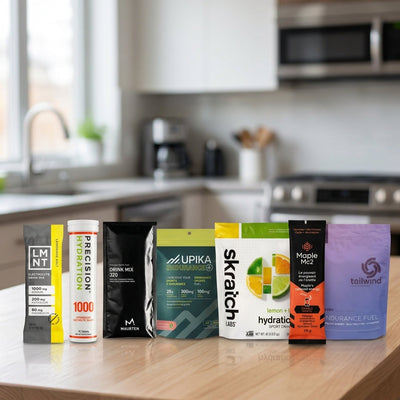
- LMNT. One stick provides 1,000 mg of sodium and no sugar. It is the product for very heavy sweating or a low-carb diet. Our article on the LMNT alternative details it.
- Gatorlyte. One bottle provides 490 mg of sodium, little sugar and sweet flavors. It is suitable for heat and heavy sweating, on a session of less than an hour and a half.
- Maple MC2. One packet provides 273 mg of sodium and 28 g of carbohydrates. It is suitable for regular training where you want to hydrate and fuel the effort with a single product.
You can also combine. Some athletes drink a product rich in salt before a big heat, then a drink with carbohydrates during exercise.
How to read the label of an electrolyte drink

Before choosing any bottle, take 30 seconds to check five points. It prevents you from comparing products that are not measured in the same way.
- The portion size. A 355 mL bottle and a 591 mL bottle do not compare by container, only by 100 mL.
- Sodium. It is the number that counts when you sweat a lot.
- Carbohydrates and sugars. They say if the drink aims for energy or only salt.
- The ingredient list. A short list is read in one sentence. A long list often hides stabilizers and colorings.
- The price per portion. Divide the price by the number of portions before getting an idea.
With this grid, you see right away that Gatorlyte and Gatorade do not occupy the same box.
A Quebec alternative, Maple MC2
Maple MC2 is a packet of electrolytes based on maple syrup, manufactured at the Ferme St-Ours, in Montérégie. We kept the maple. We removed everything else.
Per 30 g packet, diluted in 500 to 750 mL of water.
- 110 kcal and 28 g of carbohydrates, including 14 g of sugars, which come from maple syrup
- 273 mg of sodium, 94 mg of potassium and 47 mg of calcium
- Maple syrup, salt, freeze-dried fruits and natural flavors, without coloring or artificial sweetener
Gatorlyte has more sodium and more magnesium than Maple MC2. If your problem is salty sweat and heat, it answers this need better.
Maple MC2 provides more carbohydrates and a short ingredient list. It is more suitable if you want to hydrate and fuel an effort with a single product, made in Quebec.
Try the three flavors
Maple, Maple-Blueberry, Maple-Peach. 12 packets to find your favorite.
Discovery Box | $29.99You want to compare other options? Read our guide Gatorade alternative, or our ranking of the best electrolyte drinks in Canada. For the base flavor, discover the Maple.
Frequently asked questions
In summary
Gatorlyte and Gatorade look similar on the shelves, but they serve different purposes. Gatorlyte provides a lot of sodium and little sugar. Gatorade provides less sodium and more sugar.
If you sweat a lot, Gatorlyte makes sense, with the label of your bottle in hand. If your workout lasts longer than an hour and a half, you need extra carbohydrates, and that's where a packet like Maple MC2 comes in.
The Gatorlyte vs. Gatorade comparison can therefore be summed up in one sentence. One replaces salt, the other provides sugar, and neither replaces a real strategy for long-duration exercise.
Find our active lifestyle electrolyte drink collection, or discover the three flavors with the Discovery Box.