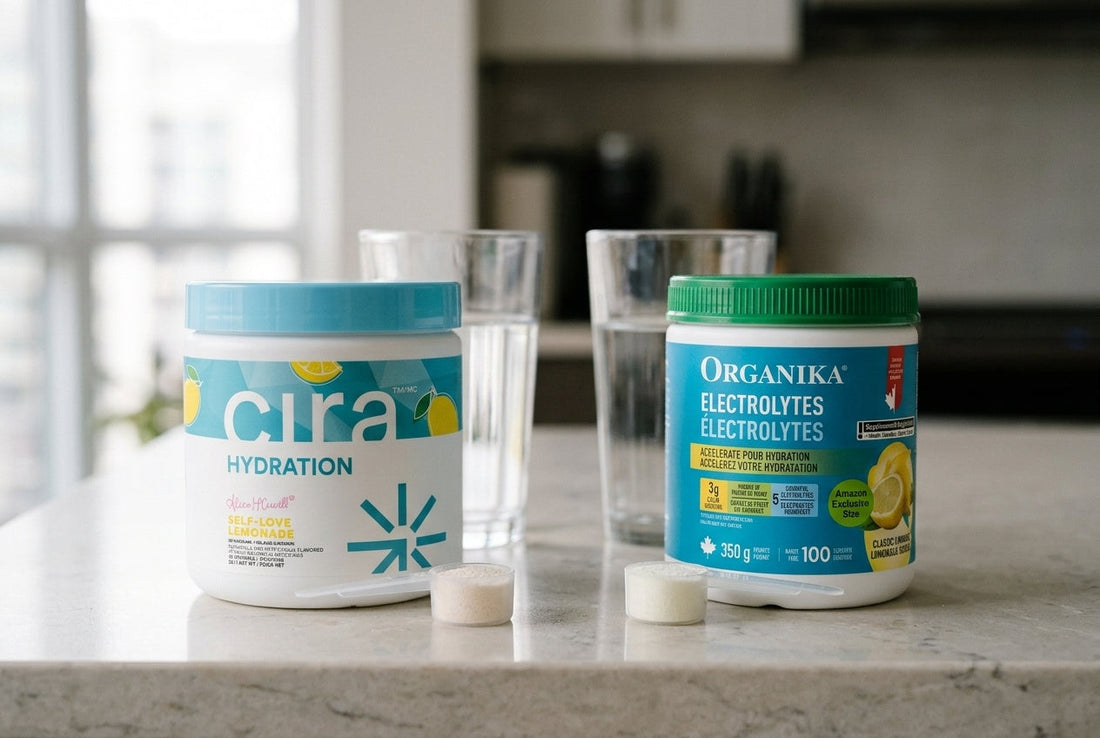
Cira or Organika? When it comes to sodium, Organika contains much more, but Cira offers a formula with taurine and vitamin C.
We put the two labels side by side, ingredient by ingredient.
Quick verdict: Cira or Organika?
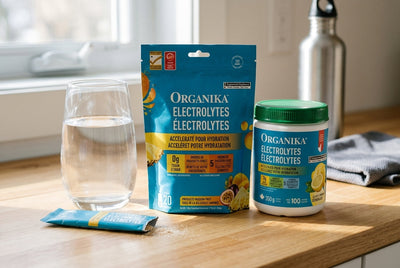
Organika Extra Strength is a simple electrolyte powder with only three minerals: sodium, potassium, and magnesium. Its biggest strength is sodium: 1000 mg per serving.
Cira is more comprehensive on paper: taurine, vitamin C, calcium, and magnesium in addition to sodium and potassium. However, it contains 100 mg of sodium per serving, compared to 1000 mg for Organika.
- Choose Organika if you sweat a lot and want maximum sodium.
- Choose Cira if you prefer a broader formula with vitamin C and taurine.
- Neither provides carbohydrates for energy. We'll get back to that below.
The criteria compared
- The ingredient list
- Electrolyte content
- Sugar and sweeteners
- Price and size
- Energy (calories and carbohydrates)
Comparison table
| Criterion | Cira Hydration Powder | Organika Electrolytes Extra Strength |
|---|---|---|
| Sodium per serving | 100 mg | 1000 mg |
| Potassium per serving | 110 mg | 186 mg |
| Calcium | Yes (calcium bisglycinate) | No |
| Sodium source | Himalayan salt | Sodium chloride |
| Additives | Taurine, vitamin C | None |
| Sweetener | Stevia (sucralose, depending on the flavour) | Stevia |
| Sugar | No sugar | No added sugar |
| Price | $32.99 for 225 g (Well.ca) | $44.99 for 180 g (regular price, Goodness Me) |
| Serving size | 1 scoop in 16 to 20 oz of water | 1 scoop in 500 ml of water |
Prices come from Canadian retailers and change often.
Why serving size changes the comparison
The numbers on a label only apply to one serving. If the two brands do not use the same measure, the comparison can be misleading.
Cira is measured with one scoop in 16 to 20 oz of water, or about 475 to 590 mL. Organika is measured with one scoop in 500 mL.
Before comparing two products, bring the numbers to the same volume of water. Otherwise, a product may seem weak or strong simply because of its serving size.
Also read the number of servings per container. This is the number that determines how long your container will last, and therefore how much you pay per drink.
The ingredients: two philosophies
The first thing that stands out is the length of the list. 
Organika, in the fruit punch version, contains sodium chloride, citric acid, natural flavouring, and two citrates (magnesium and potassium).
It also contains a vegetable colouring and stevia. It is short and easy to read. Cira adds taurine, L-malic acid, calcium bisglycinate, vitamin C, silica, and
calcium silicate (anti-caking agents). And the list changes depending on the flavour: some use sucralose instead of stevia.
Taurine, vitamin C, and calcium: what they change
Cira adds ingredients that Organika does not have. They provide a more varied formula, but they do not replace sodium.
Taurine and vitamin C are extras. Calcium is a mineral that you also lose through sweat, but in smaller amounts.
What accounts for most losses during hot exercise remains sodium. This is why the comparison is mainly based on this number.
Electrolytes: sodium makes the difference
Organika contains 1000 mg of sodium and 186 mg of potassium per serving. It is a very salty formula, designed to replace what you lose in sweat.
Cira uses Himalayan salt, potassium citrate, magnesium citrate, and calcium.
Per serving, it contains 100 mg of sodium and 110 mg of potassium. It therefore contains ten times less sodium than Organika.
Key takeaway
More sodium is not always better. If you sweat little or work out for less than an hour, a 1000 mg serving may be more than you need.
Want energy in addition to electrolytes?
Organic maple syrup, 273 mg of sodium, 28 g of carbohydrates. Try the three flavours.
Discovery Box | $29.991000 mg of sodium: is it too much for you?
For someone who sweats a lot, 1000 mg of sodium per serving is a reasonable dose. For a light workout, it may be more than necessary.
If you are trying Organika Extra Strength for the first time, start with half a serving. Your stomach and taste will tell you pretty quickly if the dose is right for you.
A very salty drink also has a strong taste. Some people love it, others find it difficult to drink, and drinking less than expected harms hydration.
If you have hypertension or a salt-related medical condition, talk to a healthcare professional before consuming it regularly.
Sugar and sweeteners 
Both brands rely on stevia for sweetness, with no added sugar. At Cira, some flavours (Very Grapeful, Watermelon Sugar) use sucralose instead.
It is an easy detail to miss. If you avoid synthetic sweeteners, read the list for your flavour before ordering.
Taste and flavours: what changes from one brand to another
Stevia pleases some and leaves an aftertaste for others. Sucralose, found in some Cira flavours, also has its fans and detractors.
A very salty powder like Organika Extra Strength is more noticeable. Many people drink it more diluted or well chilled.
If you are unsure, start with the most neutral flavour. Very strong flavours tire you out quickly.
Price and size
Cira sells for $32.99 for 225 g at Well.ca. Organika costs $44.99 for 180 g at Goodness Me, with frequent discounts around $38 to $40.
The price per serving is difficult to calculate. Cira does not clearly state its number of servings, and Organika's scoop varies depending on the source.
In both cases, you mix it in about 500 ml of water. The size is equally convenient.
Calculate your cost per drink
The price of the container does not tell the whole story. Divide it by the actual number of servings to find your cost per drink.
Do the calculation with the dosage you use. If you take half a serving, a container lasts twice as long.
Also think about discounts. Organika prices often vary from one retailer to another, so compare before ordering.
Container, pouch, or scoop: what is convenient
A container requires a scoop and a dry place. In a gym bag, it takes up space and the powder can get damp.
An individual pouch fits in a pocket and measures itself. It is convenient for travel, but the packaging costs more.
Choose the size according to your use. For home, the container makes sense, and for outings, pouches are simpler.
The limits of electrolyte powders
A powder does not compensate for a lack of sleep, poor diet, or overtraining. It helps replace minerals, nothing more.
It also does not solve an excess of fluid. Drinking a lot of water alone during a long outing can dilute the sodium in your blood.
If you have frequent cramps, do not rely entirely on the powder. Also look at your hydration from the day before, the heat, and your diet.
Energy: what neither provides
Comparing the two, you quickly notice what is missing from both labels: carbohydrates. 
These are good hydration powders. But for a long outing, your body also needs fuel.
You then need a gel, a banana, or a second drink.
Electrolyte powder or water alone?
For a session of less than an hour, water is enough for most people. You get the salt back with your next meal.
A powder becomes useful when you sweat a lot, when it is hot, or when the effort exceeds an hour. It can also help you drink more if you do not like plain water.
This second point matters more than we think. The best drink is the one you drink every day without forcing yourself.
Cira or Organika depending on your sport

- Summer running. Sodium counts, so the Organika Extra Strength formula holds up better.
- Weightlifting. A one-hour session goes well with a light powder like Cira, or even with water.
- Long-distance cycling. Neither is enough on its own, because carbohydrates are missing.
- Hot yoga. You sweat a lot in a short period, and a little sodium helps.
If your sport falls between two categories, trust your sweat. If your t-shirt is covered in salt after the session, you lose a lot of sodium.
When to use each powder in your week
The same product does not have to serve for everything. Several people keep two powders depending on the day.
- Office day. A light powder flavours the water and encourages you to drink more often.
- Short and intense session. A sodium-rich powder is suitable if you sweat a lot.
- Hot day. Sodium needs increase, even without training.
- Long outing. A carbohydrate-free powder is not enough; you need to add something to eat.
Keeping two products costs more, but it avoids using a salty formula for nothing. You choose according to your day.
Who should choose what?
- You sweat a lot, in the summer, during a short session: Organika, for its sodium.
- You want a more complete formula (vitamin C, taurine, calcium): Cira.
- You run or cycle for more than an hour and want a single product: look instead towards a drink with carbohydrates.
Five questions to ask yourself before choosing

A good choice starts with a few simple questions. They prevent you from relying solely on the colour of the packaging.
- How long do your sessions last, on average?
- Do you sweat a lot, or rather little?
- Do you like the taste of stevia or sucralose?
- Do you need energy in addition to minerals?
- What budget do you want to dedicate to your hydration?
If you answer "long sessions" and "need energy", neither of these two powders is enough on its own. In other cases, sodium and taste separate them pretty quickly.
How to test a powder before adopting it
Buy a small size or a sample when possible. A big container that you do not like stays in the cupboard.
Try the powder three times, during similar sessions. Note the taste, your stomach, and the thirst that remains after.
Then compare it with the other product under the same conditions. The best powder is the one you drink without forcing yourself.
The mistakes to avoid with an electrolyte powder
- Comparing different servings. Always bring the numbers to the same volume of water.
- Choosing according to the price of the container. The cost per drink is the only number that counts.
- Ignoring the flavour. A powder that you drink reluctantly does not hydrate you.
- Relying on the powder for energy. Neither of these two brands provides carbohydrates.
- Forgetting your own sweat. Two people doing the same session do not lose the same amount of salt.
Keep these five points in mind when ordering. They prevent an extra container in the cupboard.
What we take away from the comparison
Cira and Organika do not play in the same category. One relies on a varied formula, the other on a high dose of sodium.
Neither solves the energy question. For a long outing, you need to add carbohydrates, in the form of food or drink.
Choose according to your sweat, your taste, and your budget. Test before committing to a large size.
Why Maple MC2?

Maple MC2 plays another role. We are not a zero-sugar powder, we are deliberately something else.
Each pouch contains organic maple syrup from Ferme St-Ours, in Montérégie.
- 28 g of carbohydrates
- 110 calories
- 273 mg of sodium
- 94 mg of potassium
- 47 mg of calcium
- 15 mg of magnesium
The ingredients are limited to maple syrup, salt, freeze-dried fruits, and natural flavours.
On the sodium side, Organika does better than us (1000 mg versus 273 mg). If your number one need is salt, that is the one you need.
If you want hydration and energy in the same glass, with a short ingredient list and a mild taste, MC2 is made for you. One pouch mixes in 500 ml of water, at $2.79 per pouch or $2.50 in a box of 12.
Taste maple as fuel
Maple, Maple-Blueberry, and Maple-Peach, in a single box. Free shipping from $75.
Discovery Box | $29.99Frequently asked questions
In summary
Organika focuses on sodium, with 1000 mg per serving. Cira offers a broader formula, with vitamin C and taurine, but only 100 mg of sodium.
Neither provides carbohydrates for exercise lasting more than an hour. That is the role of Maple MC2.
Find our active lifestyle electrolyte drink collection.
To learn more, read our review of Organika electrolytes and our ranking of natural electrolyte drinks in Canada.