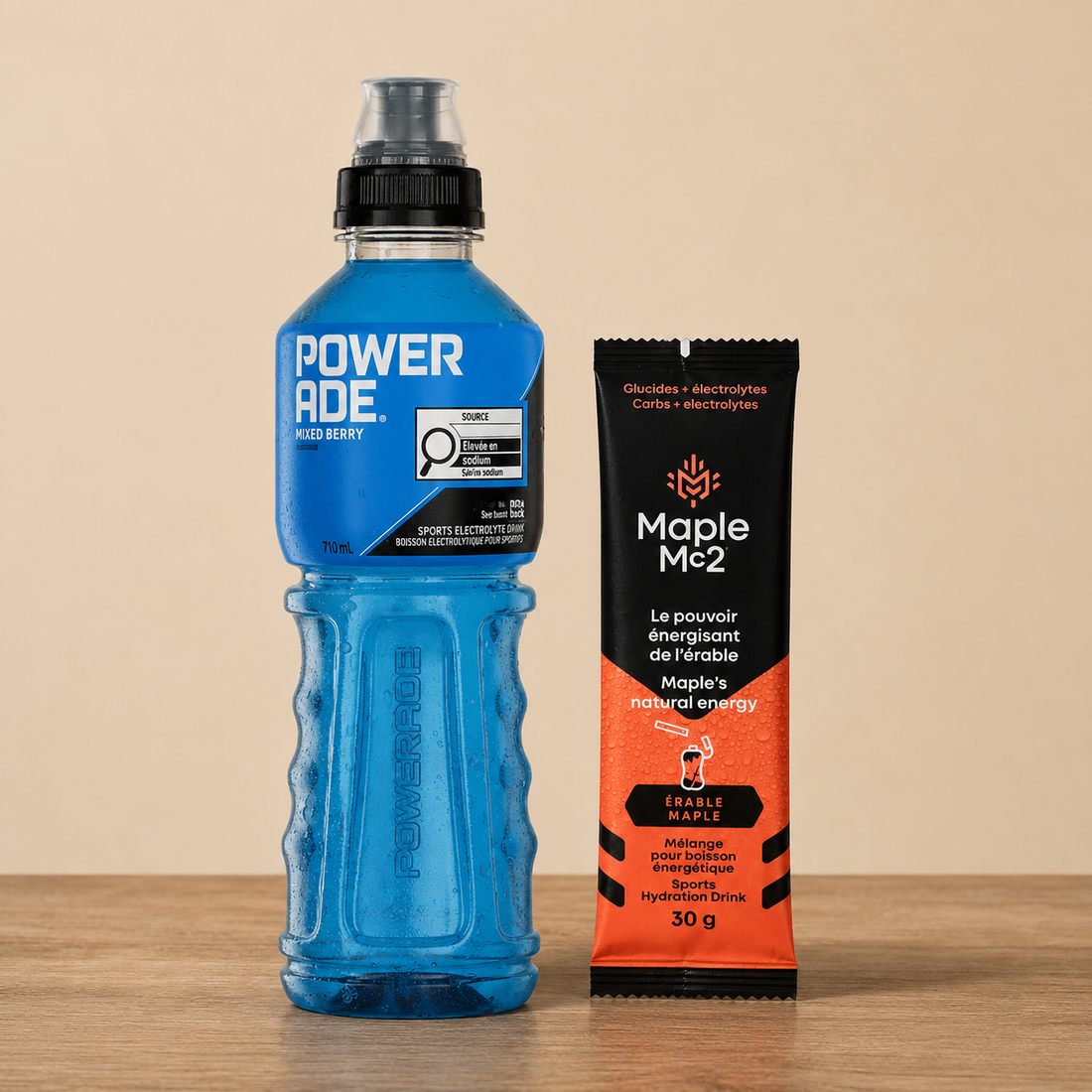
You just finished a workout. You open the fridge and grab a bottle of Powerade.
Pick it up. Turn it over. Read the ingredient list.
- Sucralose
- Acesulfame potassium
- Disodium calcium EDTA
- Brilliant Blue coloring
Did you know those ingredients were in there?
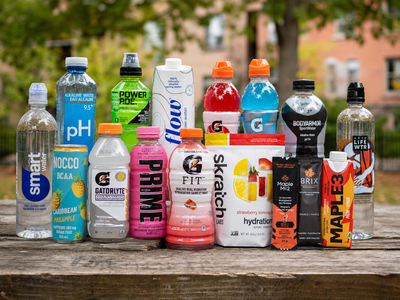
On the Facebook group "J'achète Québécois, j'achète local et Canadien" (I buy Quebecois, I buy local and Canadian), athletes are explicitly asking for a Canadian substitute for Gatorade and Powerade Zero.
The demand is public, documented. Yet, no natural beverage made in Quebec appears in the top Google results for this search.
Maple MC2 is the natural alternative to Powerade that Quebec athletes are already looking for.
What Powerade really contains

Powerade comes in two versions in Canada: the original version and the Zero version. Both are based on the same basic electrolyte system, but their composition differs significantly.
Original Powerade, per 710 mL bottle:
- 160 kcal
- 41 g carbohydrates, including 41 g sugars (sugar and glucose-fructose)
- 480 mg sodium
- 150 mg potassium
- Coloring, disodium calcium EDTA, natural and artificial flavor
Powerade Zero, same 710 mL format:
- 5 kcal
- 0 g carbohydrates
- 480 mg sodium
- 150 mg potassium
- Sucralose, acesulfame potassium, disodium calcium EDTA, coloring
Removing sugar also removes energy. Powerade Zero hydrates, but provides nothing to fuel effort.
Why Quebec athletes are looking for a Canadian substitute for Powerade
Powerade belongs to Coca-Cola. The product is distributed in Canada, but nothing in its formulation or manufacturing is Quebecois or Canadian.
On several Facebook groups as well as on several Reddit threads, the demand regularly comes up: a substitute made here, with ingredients we recognize.
The Journal de Montréal also questioned the health relevance of commercial sports drinks, including Powerade and Gatorade, for everyday training.
- Synthetic ingredients difficult to pronounce
- No natural, Quebec-made option in search results
- An international brand, not a local product
The real issue isn't just where the product is sold. It's where its ingredients come from.
To remember
- Original Powerade: 41 g of sugar per bottle.
- Powerade Zero: 0 g carbohydrates, but 2 artificial sweeteners.
- Maple MC2: 28 g carbohydrates from maple syrup, without sweetener or coloring.
Existing natural options and their limits

Before looking for a brand, many athletes try homemade solutions.
- Coconut water: the Journal de Montréal highlights an imbalance between sodium and potassium compared to actual needs during effort
- Homemade recipes based on green tea, coconut water and lemon: effective occasionally, but impossible to dose precisely or transport easily
- Plain water: hydrates, but replaces neither electrolytes nor carbohydrates lost during effort
These options are temporary fixes. They do not replace a product designed for effort, with consistent dosage every time.
Making your own sports drink: why it's not sustainable in the long term
The most common recipe circulating on forums: 500 mL of water, a pinch of salt, the juice of half a lemon, and a tablespoon of maple syrup or honey.
On paper, it works. In practice, problems quickly emerge.
Dosage is a guessing game.
A "pinch of salt" can contain between 150 mg and 600 mg of sodium depending on the size of your fingers and the type of salt. Too little, you don't replace what you lose in sweat. Too much, you risk stomach cramps in the middle of your effort. Commercial sports drinks exist precisely because the sodium/potassium/carbohydrate ratio must be precise for intestinal absorption to work.
Storage is a problem.
A homemade drink without preservatives goes bad in a few hours at room temperature. In summer, in a bike bottle in the sun, it's even worse. You can't prepare it for the week.
Transportation is inconvenient.
You have to prepare your drink before each workout, have the ingredients on hand, measure, mix. When traveling or competing, it's an added constraint at a time when you want to simplify your logistics.
The true cost is underestimated.
Quality sea salt, organic lemons, pure maple syrup: when you add everything up to get a result comparable to a pre-dosed sachet, you often exceed $2.79 per serving, not to mention your time.
For a relaxed Sunday morning, a homemade recipe works. For structured training three to five times a week, or on race day, the consistent dosage of a pre-dosed sachet eliminates the guesswork.
Why maple syrup works as exercise fuel

Maple syrup sugar is primarily sucrose, the same type of carbohydrate that sports drinks use to provide quick energy. The difference lies elsewhere.
- Glycemic index of about 54, compared to about 65 for white sugar: energy is released more gradually
- Naturally present minerals: manganese, riboflavin, zinc, calcium
- Low in FODMAPs, thus less risk of digestive discomfort during exercise
Sports nutrition guidelines recommend approximately 30 to 60 g of carbohydrates per hour for sustained effort lasting more than 60 minutes. A sachet of MC2 provides 28 g: the lower end of this range, with a single sweetening ingredient rather than a mixture of refined sugar and glucose-fructose.
Maple MC2, the Quebec substitute that prepares in seconds
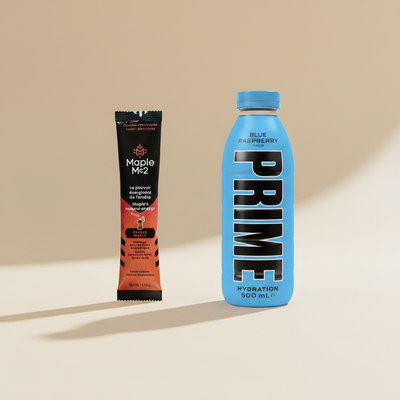
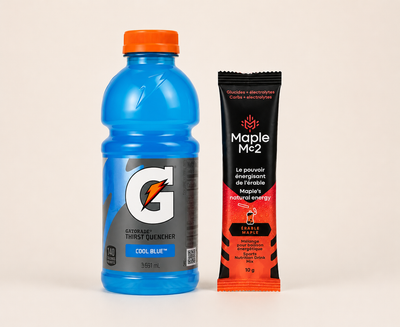
Maple MC2 is an electrolyte sachet made from organic maple syrup, produced in Saint-Ours, Montérégie.
Per sachet:
- 110 kcal
- 28 g carbohydrates, from maple syrup
- 273 mg sodium
- 94 mg potassium
- 47 mg calcium
- No artificial sweeteners, no coloring
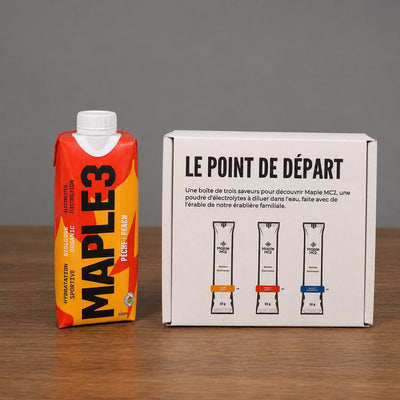
One sachet dissolves in water in a few seconds. Three flavors are available: Maple, Maple-Blueberry, and Maple-Peach. Discover our range of natural organic drinks too.
Unlike Powerade Zero, MC2 doesn't sacrifice energy to remove refined sugar. The carbohydrates come from a single recognizable ingredient: maple syrup.
Try all three flavors
Maple, Maple-Blueberry, Maple-Peach. 12 sachets to find your favorite.
Discovery Box | $29.99How to use MC2 according to your workout

One sachet dissolves in 500 to 750 mL of water. The correct dosage depends mainly on the duration of the effort.
- Less than 60 minutes: water is sufficient in most cases. MC2 becomes useful if it's hot or if you sweat a lot
- 1 to 3 hours (cycling, running, hockey): one sachet per bottle, to be drunk regularly rather than all at once
- After exercise: one sachet helps replenish sodium and carbohydrates, especially if another workout follows within 24 hours
The sachet format has a concrete advantage for cyclists: three sachets in a jersey pocket weigh less than a single 710 mL Powerade bottle, and you can refill your bottle at any fountain.
Comparison table: Powerade vs Powerade Zero vs Maple MC2
| Criterion | Powerade | Powerade Zero | Maple MC2 |
|---|---|---|---|
| Price | ~$1.00 / 710 mL | ~$1.25 / 710 mL | $2.79 / sachet |
| Calories | 160 kcal | 5 kcal | 110 kcal |
| Carbohydrates | 41 g | 0 g | 28 g |
| Sodium | 480 mg | 480 mg | 273 mg |
| Potassium | 150 mg | 150 mg | 94 mg |
| Sweeteners and additives | Sugar, glucose-fructose, coloring, disodium calcium EDTA | Sucralose, acesulfame potassium, disodium calcium EDTA, coloring |
No artificial sweeteners, no coloring |
| Format | Ready-to-drink bottle | Ready-to-drink bottle | Pre-dosed sachet to dilute |
| Origin | Coca-Cola Canada | Coca-Cola Canada | Saint-Ours, Quebec |
Powerade data: official Coca-Cola Canada pages. Prices noted at No Frills.
Who should choose what between Powerade and Maple MC2
Powerade remains relevant in certain cases.
- You need a drink immediately, from a convenience store or grocery store, with no preparation
- You are looking for a large volume ready-to-drink for a group
- The list of synthetic ingredients does not bother you
Maple MC2 is a better fit if:
- You want a short and recognizable ingredient list
- You prefer a product made in Quebec
- You're looking for real carbohydrates for your workout, not just electrolyzed water
Both hydrate. Only one does so with a single sweetening ingredient: maple syrup.
The shift towards natural alternatives among Quebec athletes
The demand for a natural substitute for Powerade doesn't come out of nowhere. For several years, running clubs, cycling groups, and triathlon communities in Quebec have been increasingly discussing what they put in their bottles.
Maple syrup often comes up in these conversations, not as a marketing trend, but as an ingredient that Quebec athletes have known since childhood. At the starting lines of local races, fewer and fewer Powerade bottles are seen in hydration belts.
Sports nutritionists are increasingly recommending unprocessed carbohydrate sources for exercise. Maple syrup, with its natural mineral profile and moderate glycemic index, precisely meets this recommendation.
It's not a fad. It's a return to a fuel that the body assimilates better because it is less processed.
What research says about maple and athletic performance

The advantage of maple is not limited to its moderate glycemic index.
Maple syrup contains about sixty bioactive compounds, including polyphenols with antioxidant properties. These polyphenols help reduce oxidative stress generated by intense exercise, a factor in muscle fatigue and slower recovery.
Researchers at the University of Rhode Island have even identified a compound unique to maple syrup, québécol, a polyphenol not found in any other known food.
During prolonged effort, the body produces free radicals that damage muscle cells. Maple polyphenols help neutralize these radicals, which can lead to faster recovery and less muscle soreness after training. Powerade, with its refined sugar or artificial sweeteners, offers none of these benefits.
To remember
Maple is not just a carbohydrate with a better glycemic index. It is a complete food with antioxidants and minerals not found in refined sugar or Powerade's sweeteners.
Made in Quebec: from maple syrup to sachet
Powerade is formulated and bottled by Coca-Cola Canada. Maple MC2 is made at Ferme St-Ours, in Montérégie, a family sugar bush, not a factory.
The organic maple syrup comes from Quebec sugar bushes. The mixing, packaging, everything is done on site. This means a shorter supply chain and every dollar spent staying in the local economy.
There's also the question of traceability. With MC2, you know exactly where the main ingredient comes from. Try tracing the origin of glucose-fructose or disodium calcium EDTA in your Powerade bottle.
The taste: why maple syrup goes down better than sweeteners during exercise
Powerade has a sweet and intense taste, designed to stand out on a grocery shelf. Powerade Zero adds an artificial note typical of sweeteners like sucralose, which many athletes find too present after a certain number of sips.
Maple MC2 tastes like maple, or maple with its fruity touch (blueberry or peach). Not an artificial maple flavor: the real syrup. The result is a rounder, less aggressive taste than refined sugar or sweeteners, which generally goes down better when the stomach is already stressed by effort.
Maple syrup, being less processed, also tends to be better tolerated by the digestive system during exercise, compared to refined sugar or artificial sweeteners which can cause bloating in some athletes.
Taste the difference
Just one sachet in your bottle. No coloring, no sweetener. Just maple.
Try the Discovery Box | $29.99Frequently Asked Questions
In summary
On one side: Powerade and Powerade Zero, two drinks formulated by Coca-Cola, with refined sugar or artificial sweeteners depending on the version.
On the other: Maple MC2, a natural alternative to Powerade made in Quebec, with a single sweetening ingredient, organic maple syrup.
Try the Maple, Maple-Blueberry, or Maple-Peach flavor, or discover all three with the Discovery Box.