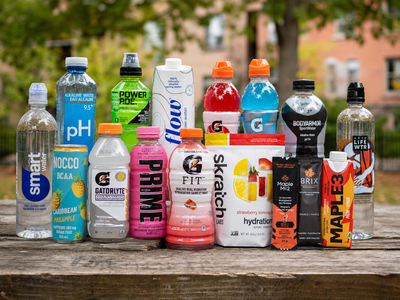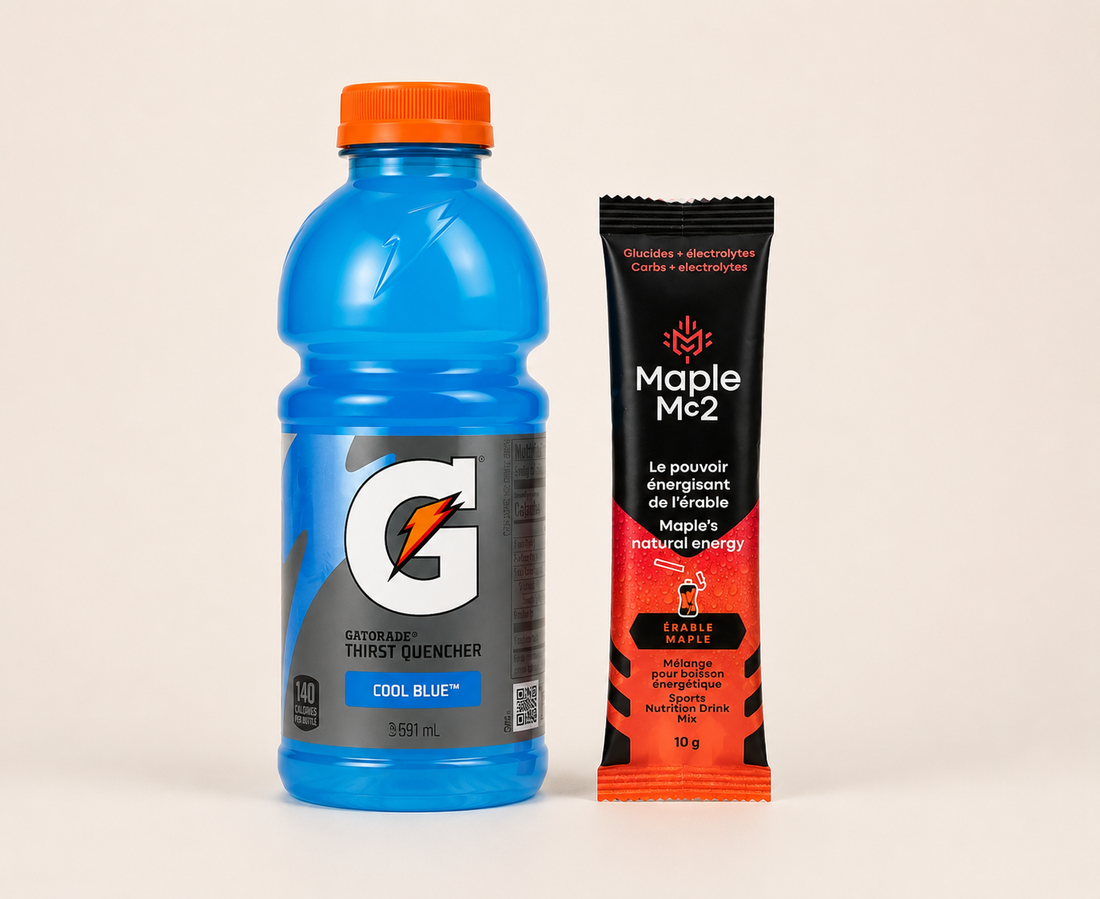
Gatorade has dominated the sports drink aisle for decades. But open the bottle and look at the label.
- Dextrose
- Coloring
- Artificial flavor
- A list of ingredients you don't really recognize
None of that comes from nature.
A quick search for a natural alternative to Gatorade mostly brings up two things: Gatorade itself, or homemade recipes to prepare with coconut water, lemon, and honey.
No ready-to-drink, Quebec-made option with a documented nutritional profile. This is exactly the gap that Maple MC2 aims to fill as a natural alternative to Gatorade.
What Gatorade really contains

The classic Gatorade format (591 ml bottle) provides 140 calories and 36g of carbohydrates, with 270mg of sodium and 75mg of potassium.
Its typical ingredients:
- Sugar and dextrose
- Citric acid
- Salt and sodium citrate
- Monopotassium phosphate
- Artificial flavor
- Coloring
The Gatorade Zero version (also 591 ml) drops to 10 calories and 2g of carbohydrates. But it keeps the same electrolyte profile (270mg sodium, 75mg potassium) by replacing sugar with artificial sweeteners: 37mg sucralose and 29mg acesulfame-potassium per bottle.
Key takeaway
- Classic Gatorade: added sugar and coloring.
- Gatorade Zero: artificial sweeteners and almost zero carbohydrates, therefore almost zero real energy for effort.
Why people look for a natural alternative to Gatorade

Refined sugar, artificial colors, and sweeteners often come up in criticisms of Gatorade. Many athletes want an energy source they recognize, not a chemical list.
On Reddit, users are explicitly asking for a natural bottled alternative to Gatorade. Not a recipe to make themselves.
Indeed, homemade recipes are currently abundant: coconut water, lemon juice, honey, sea salt. The problem is the lack of fixed dosage.
- No guaranteed nutritional value from one preparation to another
- Ingredients to buy separately
- Preparation to make each time
And even when well made, these homemade recipes do not offer precise control over the amount of carbohydrates or electrolytes consumed. For serious effort, this imprecision becomes a real problem.
Other natural options on the market
MC2 is not the only natural alternative to Gatorade. Other brands are also positioned in this niche.
- Skratch Labs: sports mixes made from cane sugar and electrolytes, manufactured in Colorado.
- Nuun: low-calorie effervescent tablets, focused on electrolytes.
- LMNT: sugar-free and artificial sweetener-free electrolyte packets.
- Tailwind: powder for long-distance endurance, popular among ultra-runners.
- BioSteel: Canadian brand (Ontario) using natural sweeteners like stevia.
Each has its philosophy and its audience. The particularity of Maple MC2 is organic maple syrup as the central carbohydrate source, and entirely Quebec-made production.
Maple, the ingredient even homemade recipes recommend

One of the most interesting recipes comes from Érable du Québec, the maple industry's sectoral organization. Their "Gatorade-style but natural" recipe: water, orange juice, maple syrup, and salt.
Maple is not a marketing choice. Raw maple sap is 98% water. Syrup is this same water concentrated by evaporation: about 40 liters of maple sap to produce 1 liter of syrup.
Result: a much higher nutritional and energetic density per gram than flavored water.
Maple MC2 starts from exactly the same logic. But in a ready-to-use, pre-dosed, and laboratory-tested version.
The glycemic index: why the source of carbohydrates changes everything
Gatorade's sugar and dextrose have a high glycemic index. Energy comes quickly, but also drops quickly.
Maple syrup has a lower glycemic index, around 54, compared to 85 to 105 for maltodextrin used in several industrial sports drinks and gels, according to data published on PubMed.
Concretely: a more gradual energy release, less of a peak followed by a trough, more suitable for sustained effort of 45 minutes or more.
Key takeaway
- Maple syrup glycemic index: around 54.
- Maltodextrin (Gatorade and several competitors): 85 to 105. Almost double.
What research says about maple and performance
The advantage of maple is not limited to the glycemic index.
Maple syrup contains 67 bioactive compounds, including polyphenols with antioxidant properties. Polyphenols help reduce oxidative stress generated by intense exercise, a factor in muscle fatigue and slower recovery.
In terms of minerals, maple syrup naturally provides manganese, zinc, calcium, potassium, and magnesium. Not synthetically added: already present in the sap.
Researchers at the University of Rhode Island even identified a compound unique to maple syrup, quebecol, a polyphenol not found in any other known food.
These antioxidants also play a role in inflammation management.
During prolonged effort, the body produces free radicals that damage muscle cells. Maple polyphenols help neutralize these radicals, which can lead to faster recovery and less muscle soreness after training.
For comparison, maple syrup has antioxidant capacity similar to that of broccoli or tomato. Gatorade's dextrose and sucralose offer absolutely no antioxidant benefits.
Key takeaway
Maple is not just sugar with a better glycemic index. It is a whole food with antioxidants and minerals not found in industrial sugars.
Maple MC2, the natural ready-to-drink alternative

The core fuel of Maple MC2 is organic maple syrup. Not maple-flavored water. Four ingredients: maple syrup, salt, freeze-dried fruits, natural flavors.
Per 30g sachet:
- 110 calories
- 28g carbohydrates
- 414mg total electrolytes (sodium 273mg, potassium 94mg, calcium 47mg, magnesium 15mg)
The sachets are made at Ferme St-Ours, in Montérégie. A family sugar bush, not a factory.
Try maple as fuel
Organic maple syrup, 414mg electrolytes, 28g carbohydrates per sachet.
Discover Maple | $2.79And the taste?
This is often the first question. Gatorade has a sweet, chemical taste, recognizable among thousands. It's a taste many athletes are used to, but which more and more find sickening after 60 minutes of effort.
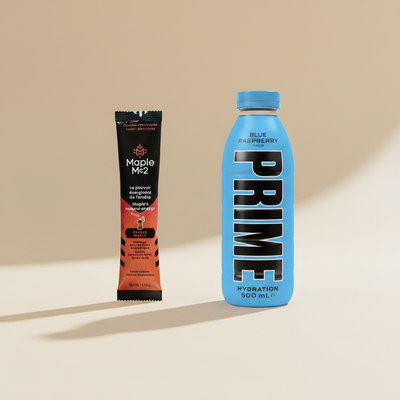
Maple MC2 tastes like maple or maple with its flavor (peach or blueberry). Not an artificial maple flavor, but real syrup. The result is a round taste, less aggressive than refined sugar, which goes down better when the stomach is already challenged by effort.
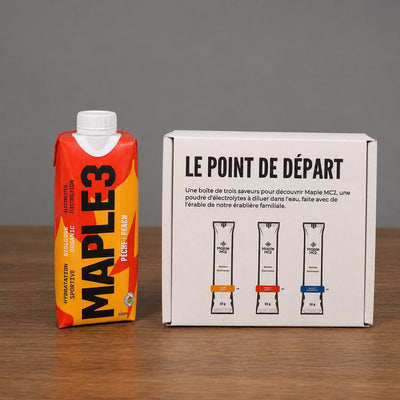
The three flavors (maple, maple-blueberry, and maple-peach) also allow for variety from one workout to another, which the Gatorade format makes more difficult since each bottle is a 591 ml commitment to the same taste.
There's also the digestive aspect.
During intense effort, the stomach is already under pressure. Refined sugar and artificial sweeteners can cause cramps, bloating, or nausea in some athletes. Maple syrup, being less processed, tends to be better tolerated by the digestive system during exercise.
How to integrate this alternative into your training

Before effort
One sachet 30 to 45 minutes before starting, diluted in 500 ml of water. This allows the carbohydrates to be available when you need them.
During effort: your natural alternative to Gatorade in action
For efforts longer than 60 minutes, one sachet every 45-60 minutes maintains carbohydrate intake within the recommended window of 30 to 60 g/hour.
After effort
The 28g of carbohydrates and 414mg of electrolytes help replenish reserves faster than a simple bottle of water.
The natural shift of Quebec athletes
The movement doesn't come out of nowhere. For several years, endurance athletes in Quebec have been questioning what they put in their water bottles.
Running clubs, cycling groups, and triathlon communities are increasingly discussing natural nutrition during exercise. Maple syrup often comes up in these conversations, not as a marketing trend, but as an ingredient that Quebec athletes have known since childhood.
At the starting lines of local races, fewer and fewer Gatorade bottles are seen in hydration belts. Sachets, homemade maple gels, personalized mixes: the reflex is changing.
Quebec sports nutritionists are increasingly recommending unprocessed carbohydrate sources for exercise. Maple syrup, with its natural mineral profile and moderate glycemic index, precisely meets this recommendation. It's not a fad: it's a return to a fuel that the body assimilates better because it is less processed.
It was this observation that prompted the creation of Maple MC2. Not to invent a need, but to respond to a shift that was already underway.
Choosing local: beyond the label
Gatorade is manufactured by PepsiCo in the United States. Each bottle crosses the border before arriving on shelves in Quebec.
Maple MC2 is produced at Ferme St-Ours, in Montérégie. The maple syrup comes from Quebec sugar bushes. The packaging, the blending, everything is done here.
This means a shorter supply chain, a reduced carbon footprint, and every dollar spent staying in the local economy. For an athlete who is already careful about what they put into their body, knowing where their fuel comes from and who makes it matters.
There's also the issue of traceability. With MC2, you know exactly where each ingredient comes from. The organic maple syrup is certified, production is documented, and the sugar bush is accessible. Try to trace the origin of the dextrose in your bottle of Gatorade.
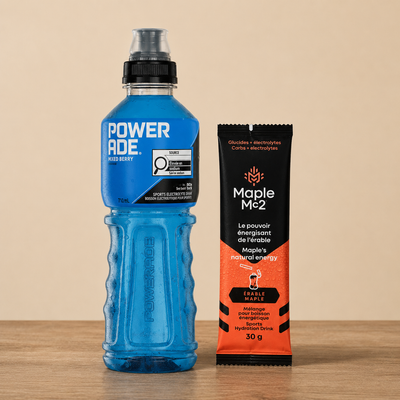
Comparative table: Gatorade vs Gatorade Zero vs Maple MC2
| Criterion | Classic Gatorade | Gatorade Zero | Maple MC2 |
|---|---|---|---|
| Format | 591 ml (bottle) | 591 ml (bottle) | 30 g sachet |
| Calories | 140 kcal | 10 kcal | 110 kcal |
| Carbohydrates | 36 g | 2 g | 28 g |
| Sodium | 270 mg | 270 mg | 273 mg |
| Potassium | 75 mg | 75 mg | 94 mg |
| Total electrolytes | 345 mg | 345 mg | 414 mg |
| Key ingredients | Sugar, coloring, artificial flavor | Sucralose (37 mg), acesulfame potassium (29 mg) | Organic maple syrup, salt |
| Glycemic index of carbohydrate source | High (dextrose) | Not applicable (almost zero carbohydrates) | Moderate (maple, GI ~54) |
| Origin | United States (PepsiCo) | United States (PepsiCo) | Saint-Ours, Quebec |
| Price | $2.49 / bottle (No Frills) | Approx. $1.55 / bottle ($9.29 / 6, IGA) | $2.79 / sachet ($29.99 / 12) |
Who should choose what

Choose classic Gatorade if:
- You want an immediate ready-to-drink option, zero preparation
- You can find it everywhere: convenience store, grocery store, vending machine
- The classic sweet taste doesn't bother you
Choose Gatorade Zero if:
- You want zero calories, regardless of actual energy during effort
- Artificial sweeteners don't concern you
Choose Maple MC2 if:
- You want a real intake of carbohydrates with a moderate glycemic index during effort
- You prefer a short and recognizable ingredient list
- You want to support a Quebec-made product, manufactured at Ferme St-Ours
- The light sachet format suits you for the field
Frequently asked questions
In summary
On one side: Gatorade, an industrial sports drink, sugary or artificially sweetened, but available everywhere and ready to drink. On the other: a natural alternative to Gatorade like Maple MC2, with a central ingredient you recognize, a more moderate glycemic index, made in Quebec.
Discover our maple, maple-blueberry, and maple-peach flavors, or try them all with the discovery box.