You’re finishing a 21-15-9. The gym floor is soaked, your t-shirt is too, and your mouth tastes like metal.
In your bag, you have one of these three things:
- a bottle of lukewarm water
- a half-flat blue Gatorade from the corner store
- a 1,000 mg sodium American powder you've been drinking for a month without really knowing why
CrossFit is unique: it’s short, it’s intense, and you walk out of there drenched.
And most electrolyte drinks were designed for endurance, not for a WOD. It’s not certain they’re made for you.
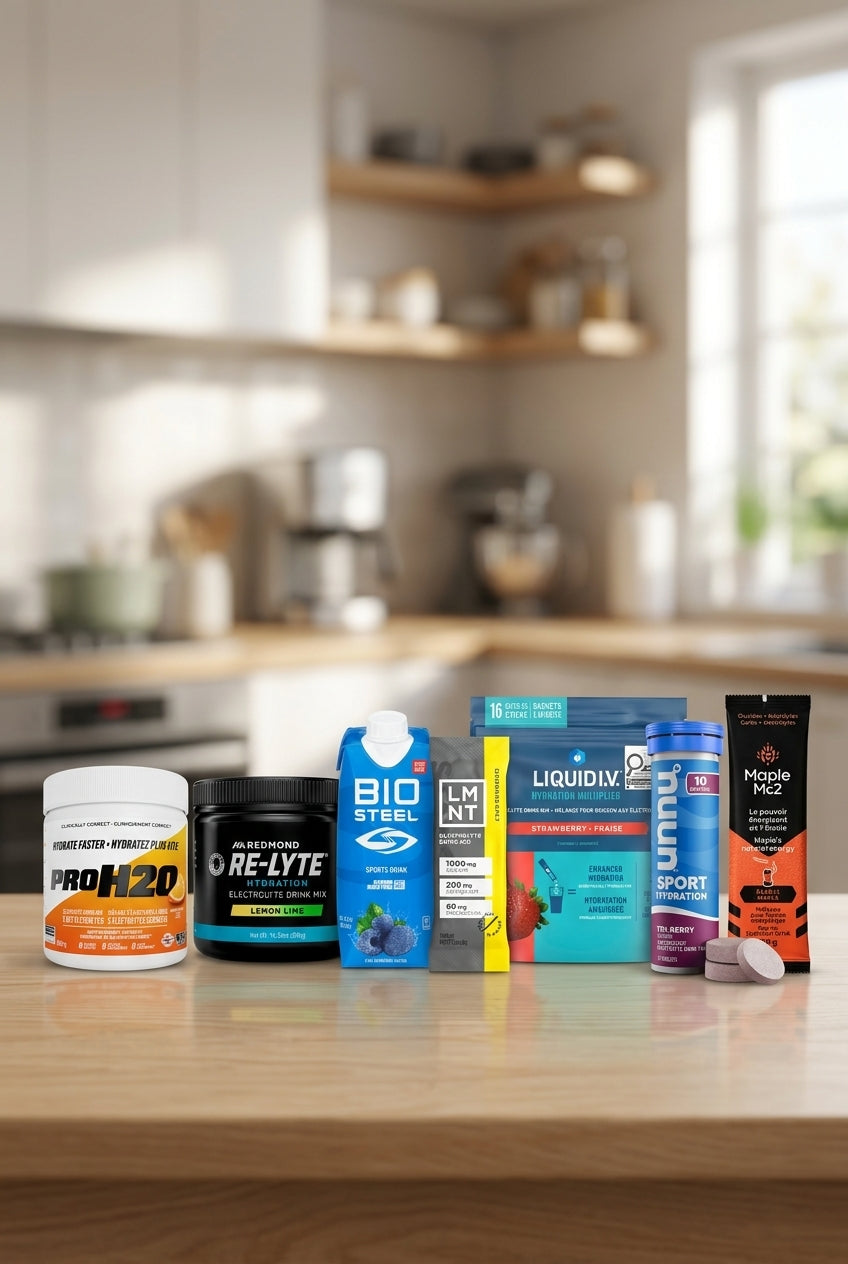
We compared seven products, including our own, based on criteria we explain below. Here is our ranking of the best electrolyte drinks for CrossFit, along with the drawbacks of each.
What an electrolyte drink needs to do for CrossFit
A WOD often lasts between 5 and 30 minutes. That seems short, but add in the warm-up, the strength work beforehand, and the accessories afterwards. Your full session usually lasts around an hour, sometimes more.
During this time, you lose sodium through sweat. How much? No one can tell you without testing, and that’s where the marketing gets off track.
Translation: the person next to you on the rack who leaves white streaks on their t-shirt doesn't have the same needs as you.
So, a good drink for CrossFit must satisfy four things:
- provide enough sodium to actually matter, without forcing a dose you didn't ask for
- be drinkable without making you gag during intense effort
- not make you run to the bathroom between two rounds
- cost a price that allows you to drink it at every session, not just on Saturdays
Keep in mind
Cramps are not proven to be caused by an electrolyte deficiency. A narrative review of exercise-associated muscle cramps points instead to neuromuscular fatigue. If a salesperson promises "zero cramps" with a packet, be wary.
We elaborate on this point in our guide on how to prevent muscle cramps in sports.
Our comparison criteria
We looked at seven products sold in Canada, based on six points:
- Sodium per serving, because it's the number everyone fights over
- Carbohydrates and sugar, because a one-hour session doesn't have the same needs as an 8-minute WOD
- The ingredient list, to see what's in the packet besides salt
- Price per serving, calculated from the price displayed on the brand's website
- Availability in Canada, including delivery and format
- Digestive tolerance, as far as we can judge from the ingredients (we didn't test in a lab)
A word on transparency: Maple MC2 is our product (it’s part of our fitness and CrossFit collection). We placed it in first position because our ranking rewards the real-world usage of a gym athlete training four or five times a week, not because it wins on every criterion.
It doesn't win on sodium, by the way, and we state that in its product sheet just as we do in the table.
Each number comes from the brand's official sheet or a cited source. When data wasn't confirmed in Canadian dollars, we wrote it as is rather than inventing a price.
The 7 best electrolyte drinks for CrossFit
#1 Maple MC2 Maple: the most versatile for a full session

Maple MC2 Maple
$2.79 per packet, $2.50 in a box of 12 ($29.99)
For whom: the athlete who trains often, wants to drink something at every session, and doesn't need to load up on 1,000 mg of sodium.
- 414 mg of electrolytes per 30 g packet: sodium 273 mg, potassium 94 mg, calcium 47 mg. Magnesium (15 mg) is extra, not counted in this total.
- 28 g of carbohydrates and 110 kcal, sourced from maple syrup, with no added amino acids or vitamins.
- Certified organic maple syrup. The finished drink is not, because salt and natural flavors are not covered by this certification.
- Gluten-free, vegan, made at the Ferme St-Ours, in Montérégie.
Points to consider: 273 mg of sodium is about four times less than LMNT. If you sweat a lot, this isn't enough on its own. And with 28 g of carbs, this isn't a product for someone who wants zero sugar.
Why #1 then? Because a CrossFit session isn't just three minutes of burpees. Between the strength, the WOD, and the accessories, you burn energy for an hour.
The 28 g of carbs cover that without needing to add a gel on the side. And the price remains reasonable for regular use.
#2 LMNT: the benchmark for sodium

LMNT Recharge
$1.50 US per stick in a box of 30, free shipping to Canada on orders over $100 US
For whom: the heavy sweater, the athlete training in heat, or someone who has already had their sweat measured.
- 1,000 mg of sodium, 200 mg of potassium, and 60 mg of magnesium per stick
- Sugar-free formula
- Eleven flavors available, including several savory ones (Citrus Salt, Watermelon Salt, Chocolate Salt)
Points to consider: 1,000 mg of sodium is a lot. Many people find the taste very salty. The price is in US dollars, with shipping fees below $100 US. And zero carbs means zero energy: you need to find it elsewhere during a long session.
We also wrote a more detailed comparison: which natural alternative to LMNT to choose in Canada.
#3 Redmond Re-Lyte: unrefined sea salt

Redmond Re-Lyte Hydration
Price varies by Canadian retailer
For whom: someone who wants a complete salty and mineral profile, with a readable ingredient list.
- 810 mg of sodium, 400 mg of potassium, 50 mg of magnesium, and 60 mg of calcium per serving (flavored versions). The unflavored version goes up to 1,000 mg of sodium.
- 0 calories, 0 g of sugar
- Ingredients: Redmond Real Salt sea salt, citric acid, potassium citrate, magnesium glycinate and malate, calcium carbonate, natural flavors, stevia, coconut water powder
Points to consider: it's an American product, so price and availability depend on retailers. It provides no energy and is sweetened with stevia.
#4 PVL Pro H2O: amino acids as a bonus
PVL Pro H2O
$29.99 CA per 255 g tub, approximately $1 per serving
For whom: someone who likes an "all-in-one" supplement product with amino acids.
- 430 mg of sodium per serving
- 0 g of sugar, 0 g of carbohydrates
- Blend of amino acids, including L-glutamine, in addition to minerals
Points to consider: the ingredient list is longer than most other products in this comparison, with amino acids you might not be looking for in an electrolyte drink.
#5 Liquid I.V.: average sodium and added sugars

Liquid I.V. Hydration Multiplier
$37.99 CA for a box of 18, approximately $2.11 per packet
For whom: someone who wants a well-known brand with carbohydrates already integrated, without making their own product.
- About 500 mg of sodium, 370 mg of potassium, 11 g of carbohydrates and 45 kcal per packet, according to the brand's public nutritional sheets
- Cane sugar and dextrose as a carbohydrate source
- Added vitamins C, B3, B5, B6, and B12
Points to consider: the carbs come from added sugars (cane sugar, dextrose), not from a whole food. The price per packet is higher than the ranking average.
#6 Nuun Sport: the tablet format

Nuun Sport
$7.49 for a tube of 10 tablets on the brand's site, or about $0.75 per tablet
For whom: someone who wants something light to slip into a gym bag, without having to prepare a powder.
- 300 mg of sodium per 16 fl oz serving
- 1 g of sugar, 10 kcal
- Sodium, potassium, chloride, calcium, and magnesium on the menu
Points to consider: a tube only contains 10 tablets, so the price adds up quickly if you drink one at every session. The sodium remains moderate, and the effervescence isn't to everyone's liking during exercise.
For a comparison of formats, we have a dedicated article: powder, tablet, or liquid, which format to choose.
#7 BioSteel: the well-known Canadian brand, but little sodium

BioSteel Hydration Mix
$59.99 CA for a 45-serving tub, approximately $1.33 per serving
For whom: someone who wants a very light drink, well-known to Canadian athletes, for active recovery days or low-intensity sessions.
- 140 mg of sodium, 30 mg of potassium, 2 mg of magnesium, and 11.8 mg of calcium per 7 g serving
- 5 calories, 1 g of carbs, 0 g of sugar, sweetened with stevia
- B vitamins, amino acids, and beet powder on the menu
Points to consider: 140 mg of sodium is low for a WOD. That's why it finishes last: it's good for light hydration, but not for a session where you are really sweating.
Try all three flavors
Maple, Maple-Blueberry, Maple-Peach. 12 packets to find the one that suits you best during exercise.
Discovery Box | $29.99Comparison table of electrolyte drinks for CrossFit
| Brand | Sodium/serving | Carbs/sugar | Calories | Approx. price/serving | Format |
|---|---|---|---|---|---|
| Maple MC2 Maple | 273 mg | 28 g carbs | 110 | $2.50 to $2.79 | 30 g packet |
| LMNT | 1,000 mg | Sugar-free | Not specified | $1.50 US | Stick |
| Redmond Re-Lyte | 810 to 1,000 mg | 0 g | 0 | Varies by retailer | Powder |
| PVL Pro H2O | 430 mg | 0 g | Not specified | Approx. $1 | Powder (tub) |
| Liquid I.V. | Approx. 500 mg | Approx. 11 g | Approx. 45 | Approx. $2.11 | Packet |
| Nuun Sport | 300 mg | 1 g sugar | 10 | Approx. $0.75 | Tablet |
| BioSteel | 140 mg | 1 g carbs, 0 g sugar | 5 | Approx. $1.33 | Powder (tub) |
How to choose based on your profile
There is no single right answer. Here is how we sort it:
- You sweat a lot, or you train in a gym without air conditioning: LMNT or Redmond Re-Lyte, for the sodium load
- You train four or five times a week and want a product you can drink at every session: Maple MC2
- You want zero sugar: PVL, LMNT, Re-Lyte, or Nuun Sport
- You want a very well-known brand with added sugar: Liquid I.V.
- Your session is light or it's an active recovery day: BioSteel
Nothing stops you from combining them. Some athletes take a sodium-rich product before a big session, and a carb-based product during the session or after.
Preparing for a Hyrox or a triathlon instead? We compared the best electrolyte drinks for Hyrox and for triathletes.
Sodium: why more isn't better

You have surely seen numbers like 1,000 mg of sodium per serving.
In our country, the average sodium intake of Canadians already exceeds the recommended target, according to a CMAJ article on sodium reduction in Canada.
That doesn't mean you don't need sodium during exercise. It means the dose should follow your sweat, not a label's promise.
An athlete who loses little sodium and drinks 1,000 mg at every session is adding a lot to their already salty diet. A heavy sweater, however, won't get by with 273 mg.
How to use your electrolyte drink in CrossFit
Before the session
Some athletes take one in 500 ml of water, 30 to 45 minutes before. Test it on a normal training day, not before a competition.
During exercise: the best electrolyte drink for CrossFit depends on duration
In a WOD of less than 15 minutes, water is often enough. If your full session stretches beyond 60 minutes or if the heat is high, a drink between rounds makes sense.
Two simple reflexes: drink in small sips rather than one big glass all at once, and don't change products on the day of a competition.
After the session
After a big workout, the goal is to get back to eating and drinking normally. A packet in water can help you catch up, and our collection of post-workout recovery drinks goes further on the subject.
Frequently asked questions
In summary
On one side, powders dosed for extreme sodium needs. On the other, a drink designed for regular training.
For most box sessions, the best electrolyte drink for CrossFit is one you will actually drink at every workout, whose taste you enjoy and that your stomach tolerates, at a price that makes sense. For us, that's Maple MC2. For very heavy sweaters, a saltier product like LMNT remains more appropriate.
Discover the Maple flavor ; Discovery Box ; View the fitness and CrossFit collection