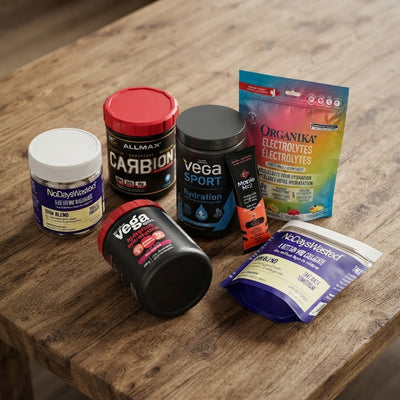
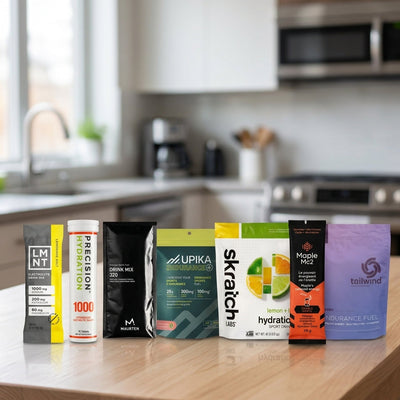
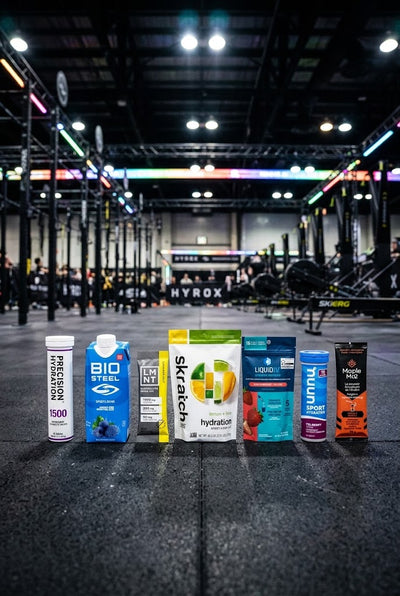
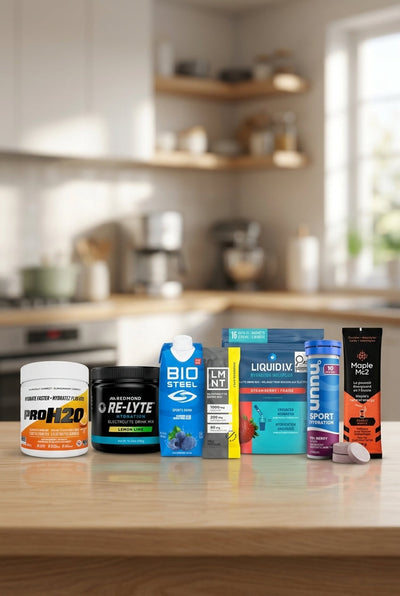
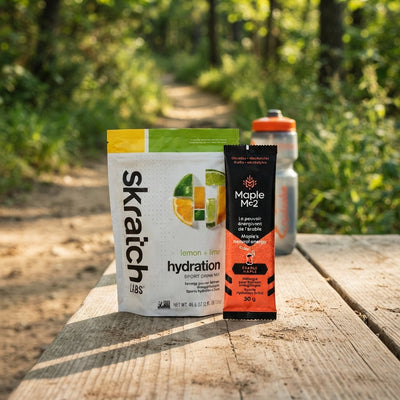
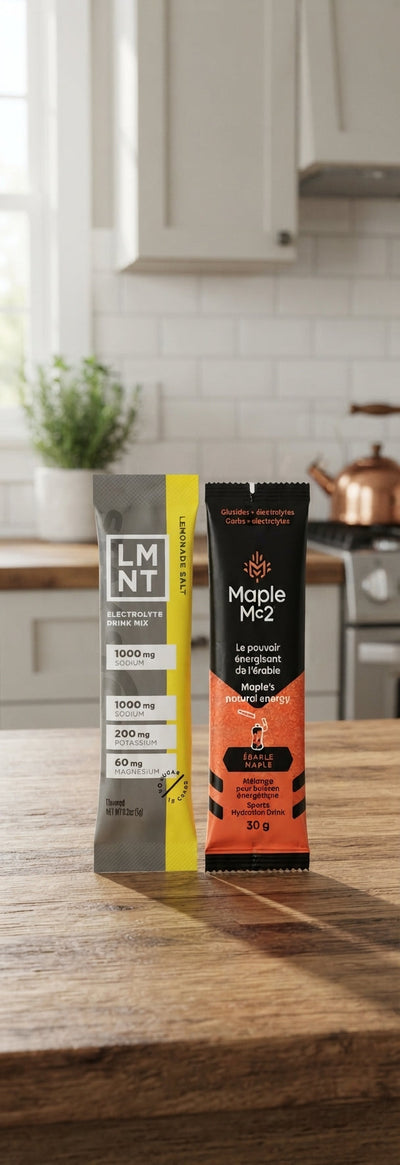
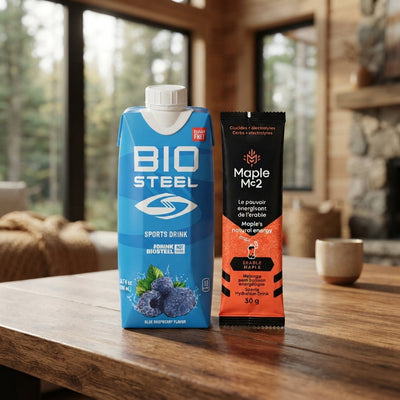
You're standing in front of the electrolyte display at your sports store, or scrolling between two tabs.
On one side, a bag of powder to mix yourself.
On the other, a case of ready-to-drink bottles.
Every seller, every brand, every fitness influencer swears their format is the right one. No one really explains why.
- Powder piles up in your bag, but do you really need to mix it yourself?
- Liquid is ready to drink, but does it cost a fortune per liter?
- Does one of the two formats make you bloat more than the other?
No format is objectively better. Each has real advantages and blind spots that are rarely hidden from you. Here's what truly distinguishes a powdered or liquid sports drink, with numbers, not slogans.
How do powdered and liquid electrolytes work?
Regardless of the format, the principle is the same. Your body loses sodium, potassium, and calcium in sweat. To effectively replace them during exercise, the concentration of the drink matters more than its packaging.
Science is clear on this point: the American College of Sports Medicine recommends a sodium concentration of 0.5 to 0.7 g per liter for efforts lasting more than an hour. Below this threshold, you're essentially drinking sugary water. Above it, your stomach has more difficulty absorbing it.
This is where the format changes the game:
- Powder allows you to adjust the concentration by varying the amount of water.
- Liquid comes at a fixed concentration, decided by the manufacturer, whether it suits you or not.
In both cases, the source of carbohydrates (refined sugar, maltodextrin, or a natural ingredient like maple syrup) influences your digestion as much as the format itself.
Isotonic, hypotonic, hypertonic: what changes depending on the format
This is the word most often missing from sports drink comparisons: tonicity. It measures the concentration of your drink relative to that of your blood plasma, around 280 to 300 mOsm/kg.
- Hypotonic: less concentrated than plasma. Fastest absorption, useful for pure hydration without high carbohydrate needs.
- Isotonic: approximately 4 to 8% carbohydrates, the concentration closest to plasma. The standard compromise for efforts over an hour.
- Hypertonic: more concentrated than plasma. Useful for carbohydrate replenishment after exercise, but slows absorption during exercise.
The key point, rarely mentioned: powder allows you to choose your tonicity, ready-to-drink liquid imposes it on you.
A concrete demonstration with Maple MC2: one sachet in 500 ml of water gives 5.6% carbohydrates, thus an isotonic drink, suitable for efforts over an hour. The same sachet diluted in 750 ml gives 3.7% carbohydrates, thus a hypotonic drink, more suitable for light hydration or in hot weather. A ready-to-drink liquid never offers you this choice; its concentration is fixed at the factory.
And if water was enough? What the consensus says
For efforts under 60 minutes and in cool weather, water is generally sufficient, a position also defended by Protégez-Vous and Radio-Canada.
The powder versus liquid debate only becomes truly relevant beyond this limit, when additional carbohydrates and sodium begin to make a real difference in performance and recovery.
Advantages of the powdered format
Powder remains the preferred format for athletes who train often, for concrete reasons.

- Adjustable dosage: you control the concentration according to the heat, duration of effort, or your digestive tolerance.
- Portability: a sachet weighs a few grams compared to 500 g to 1 kg for the equivalent in bottles.
- Lower cost per liter: you pay for the active ingredient, not for transporting water.
- Long shelf life: a dry format keeps for months without refrigeration or a tight expiration date.
- Preparation flexibility: bidon, soft flask, or even directly in a running flask.
The real advantage of powder is that it adapts to you rather than the other way around.
Advantages of the liquid format

Ready-to-drink liquid has its place, especially when convenience outweighs everything else.
- Zero preparation: you open, you drink, no mixing to do or flask to wash afterwards.
- Guaranteed dosage: the concentration is fixed, no risk of over-diluting by mistake.
- Ideal for emergencies: available at grocery stores, convenience stores, or vending machines when you haven't brought anything.
- No clumps: no poorly dissolved powder left at the bottom of the flask.
- Immediate refreshment: served cold, it hydrates and cools at the same time in hot weather.
The liquid format wins on pure simplicity. You have nothing to prepare, nothing to calculate.
To remember
Powder wins on control, cost, and bulk. Liquid wins on simplicity and speed. Neither wins on all criteria at once.
The disadvantages never mentioned
Product sheets extol the benefits. They gloss over the real frictions of each format.
Powder side:
- You need to bring a flask or bottle, which is not always practical.
- Incorrect dosing (too much or not enough water) completely changes effectiveness and taste.
- Bulk bags open to the air and absorb humidity over time.
- Impossible to check the exact dose by eye, except with a scale or dedicated spoon.
Liquid side:
- Weight and volume make transport impractical for long-distance running or cycling.
- The price per serving quickly climbs when you pay for water, the bottle, and transport.
- An opened bottle does not keep long once opened.
- The fixed concentration never adjusts to your daily needs.
What about gels? SERP sometimes contrasts drinks and energy gels. Gel provides carbohydrates without the liquid, but it needs to be consumed with water for proper absorption, which recreates the exact same dosing problem as poorly prepared powder.
These blind spots explain why a hybrid format, pre-dosed powder in individual sachets, is gaining ground.
Comparative table: powder, liquid, and pre-dosed sachet
| Criterion | Bulk Powder | Ready-to-drink Liquid | Pre-dosed Sachet (Maple MC2) |
|---|---|---|---|
| Preparation | To measure and dilute yourself | None | 1 sachet, 1 fixed amount of water |
| Dose Precision | Variable depending on technique | Fixed, guaranteed by manufacturer | Fixed, guaranteed per sachet |
| Weight for 12 servings | ~250-400 g | ~6 kg (500 ml bottles) | ~360 g |
| Storage after opening | Several months if well sealed | 24-48 h in the fridge | Until the date indicated on the sachet, without refrigeration |
| Cost per serving | Generally the lowest | Generally the highest | $2.50 to $2.79 |
| Convenience on the go | Low without dedicated flask | Low, heavy and bulky | High, individual sachet format |
| Carbohydrate Ingredient | Variable depending on brand | Variable depending on brand | Organic maple syrup |
The compromise: the pre-dosed sachet
The individual sachet takes the best of both worlds. No dosage to calculate like with bulk powder. No weight or volume to carry around like with liquid.
Maple MC2 works on this principle. Each sachet contains exactly:
- 273 mg of sodium
- 94 mg of potassium
- 47 mg of calcium
- 414 mg of total electrolytes
- 110 kcal and 28 g of carbohydrates, from organic maple syrup produced in Saint-Ours, Montérégie
You tear, you pour into 500 ml of water, done. No scale, no measuring spoon, no clumps. And unlike a ready-to-drink bottle, an unopened sachet keeps until its expiration date, without refrigeration, in a sports bag, car, or office drawer.
It's not the cheapest formula on the market nor the fastest to open. It's a conscious compromise between the control of powder and the simplicity of liquid, at $2.79 per sachet or $2.50 in a box of 12.
To remember
A Maple MC2 sachet weighs about 30g compared to 500g for an equivalent bottle, while offering a dosage as fixed and reliable as a ready-to-drink liquid.
Try all three flavors
Maple, Maple-Blueberry, Maple-Peach. 12 sachets to find your favorite.
Discovery Box | $29.99Digestion and intestinal comfort: which one causes less bloating?
This is the most common question you get, regardless of the chosen format. The answer depends less on the format than on the concentration and the ingredient.
A drink that is too concentrated, whether it's poorly diluted powder or industrial liquid loaded with sugar, slows gastric emptying and causes bloating. Research on the osmolality of exercise drinks shows that beyond a certain concentration threshold, digestive discomfort significantly increases during exercise.
This is where the carbohydrate ingredient changes everything. Maple syrup is recognized as low in FODMAPs, unlike some sweeteners and high-fructose corn syrups that cause bloating in many athletes.
In practice:
- Powder allows you to adjust the concentration if your stomach is sensitive.
- Liquid imposes a fixed, sometimes over-concentrated, concentration on you.
- The pre-dosed sachet solves this problem by setting a tested dilution, with a recognized low-FODMAP ingredient.
Common mistakes depending on the format
Some mistakes are constantly repeated, regardless of the chosen format. Here are the most common among Quebec athletes.
With powder:
- Doubling the dose for "more energy," which makes the drink too concentrated and difficult to digest.
- Leaving an open bag in a damp sports bag, which causes the powder to harden.
- Using a cold water bottle in winter without checking if the powder dissolves well in cold.
With liquid:
- Leaving a bottle to freeze in the car in Quebec winter, which alters the taste and sometimes the packaging.
- Buying in an economical format without checking the date; once opened, a bottle quickly goes bad.
- Relying on the "sport" format of a drink that remains, in fact, a classic sugary drink.
The individual sachet avoids most of these pitfalls: nothing to accidentally double, nothing that hardens, nothing that freezes before the effort.
How much does it really cost per serving?
The price displayed on the label doesn't tell the whole story. What matters is the cost per serving actually consumed, and even the cost per gram of carbohydrates depending on the format.
- Bulk powder generally costs the least per liter, but the price increases if you overdose by mistake. The cost per gram of carbohydrates varies between $0.01 and $0.11 depending on the brand.
- Ready-to-drink liquid generally costs the most, because you pay to transport water, packaging, and a product that is 90% liquid, often two to three times more expensive per gram of carbohydrates than powder.
- The pre-dosed sachet is in between: $2.79 per unit, $2.50 in a box of 12, without surprises or waste.
With free shipping for purchases over $75, a box of 12 sachets is often cheaper than an equivalent pack of ready-to-drink bottles, while weighing a fraction of the weight.
How to choose based on your activity
Daily Training
Bulk powder or pre-dosed sachets are more suitable here. You prepare at home, adjust according to intensity, and the cost per serving remains low in the long run.
Long Outing (over an hour)
The pre-dosed sachet format becomes a distinct advantage. You slip 2 to 3 sachets into your belt or backpack without the weight of as many bottles. For other options suitable for trail running and hiking, explore our trail and hiking collection.
Race or Competition
Prepare your electrolyte drink in powder or liquid form in advance and test it before race day. Never try a new format on race day. Also discover our collection for runners.
Troubleshooting or Emergency
Ready-to-drink liquid remains unbeatable if you haven't brought anything and need to hydrate immediately, at a grocery or convenience store.

Frequently Asked Questions
In summary
On the one hand, bulk powder: economical, adjustable, but demanding on dosage. On the other hand, ready-to-drink liquid: simple, immediate, but heavy and more expensive per liter.
Between powdered or liquid sports drink, there is no bad choice, only the right format for your actual use. For those looking for a reliable dosage without the weight of liquid or the calculations of bulk powder, the pre-dosed maple sachet offers this compromise.
For a complete comparison of hydration powders available in Canada, also consult our guide to the best hydration powders, or for a direct comparison with an effervescent tablet, our natural alternative to Nuun Sport. And if you prefer to prepare everything yourself, discover our article homemade vs. store-bought sports drink.
Discover the three flavors: Maple, Maple-Blueberry, Maple-Peach, or start with the Discovery Box to try them all.