You get back from a run and it is 28 degrees out. In the convenience store fridge, two bottles: a coconut water and a bright blue sports drink.
Which one has more electrolytes? And which one actually helps after your effort?
The numbers give a less simple answer than what you usually read:
- Potassium: coconut water wins, by a wide margin
- Sodium: it depends on the bottle of coconut water, and that is where the debate is decided
- Sugar and additives: sports drinks add them, plain coconut water does not
Neither one solves everything. There is a third route you rarely see in comparisons: a natural fuel with a known dose.
Coconut water, Gatorade, Powerade and Maple MC2: the numbers side by side
A bottle of Gatorade is 355 ml and a Powerade is 710 ml. To compare fairly, we bring everything down to 100 ml. The Maple MC2 sachet is calculated mixed into 500 ml of water.
| Per 100 ml | Fresh coconut water | Bottled coconut water | Gatorade | Powerade | Maple MC2 |
|---|---|---|---|---|---|
| Sodium | 105 mg | 21 mg | 45 mg | 68 mg | 55 mg |
| Potassium | 250 mg | 121 mg | 13 mg | 21 mg | 19 mg |
| Calories | 19 kcal | 31 kcal | 23 kcal | 23 kcal | 22 kcal |
| Sugars | 2.6 g | 7.5 g | 5.9 g | 5.8 g | 2.8 g |
| Dosage | Varies with the fruit | Varies with the brand | Standardized | Standardized | Standardized (sachet) |
Sources: USDA FoodData Central (fresh coconut water, per 100 g), USDA Branded Foods label (Vita Coco, 240 ml), Gatorade Thirst Quencher label (355 ml), Powerade Canada product page (710 ml) and the Maple MC2 product page. Per-100 ml values are calculated from these labels.
What it tells us:
- Potassium: coconut water has 9 to 19 times more than Gatorade depending on the version. That is its real strength.
- Sodium: from 21 to 105 mg per 100 ml, depending on whether you look at a bottled coconut water or the USDA reference for fresh. A fivefold gap for the same product name. Gatorade and Powerade land in between, with a fixed dose.
- Sugars: Maple MC2 mixed into 500 ml has 2.8 g per 100 ml, versus about 5.8 g for both sports drinks and 7.5 g for the bottled coconut water.
Maple MC2 does not win everywhere. It has less potassium than coconut water and less sodium than Powerade. Its strength is elsewhere: a known dose, with no dyes.
What coconut water really provides (and what it does not)

Coconut water has a good reputation, and it partly earns it. It is natural, low in sugar when fresh, and rich in potassium.
Its weak spot is sodium. That is the electrolyte you lose the most in sweat, and its level in coconut water is never guaranteed.
The gap in the table shows it: 21 mg per 100 ml in a bottled coconut water, 105 mg for the USDA figure for fresh coconut water. That is not a manufacturing flaw, it is the fruit changing:
- The coconut variety
- How ripe it is at harvest
- The soil and the climate
- The brand's process
For a snack or a short session, it makes no difference. When you are preparing for a long outing, you never know how much sodium you are drinking.
What studies say about rehydration
One study directly compared water, pure coconut water, coconut water from concentrate and a carbohydrate-electrolyte sports drink (Kalman et al., 2012).
Twelve trained men ran for 60 minutes on a treadmill, until they had lost about 2% of their body weight in sweat. They then drank 125% of the fluid they had lost, before a final test to exhaustion.
The result: no significant difference in hydration, heart rate or time to exhaustion (between 11.9 and 12.8 minutes depending on the drink).
One detail few comparisons mention: three hours after the effort, participants reported more bloating and stomach upset with coconut water than with water or the sports drink.
It is a small study, done on men, with a single 60-minute effort. For that kind of effort, coconut water hydrates as well as a sports drink. For a longer or hotter effort, the study says nothing, and that is exactly where sodium starts to matter.
Why sodium matters so much
When you sweat, you lose water, but also sodium. If you only replace the water, the sodium in your body gets diluted.
Sodium also helps your body absorb and hold on to the water you drink. That is why it sits on almost every sports drink label, and why we look at it first.
For a short session, this mechanism has no real consequence. On a long effort with heavy sweating, it is the variable to control.
What is in an industrial sports drink
Sports drinks have a real advantage: their composition does not change from one bottle to the next. You know how much sodium you are drinking.
Here is what the labels say:
- Powerade (710 ml, Canadian product page): 480 mg of sodium, 150 mg of potassium, 41 g of sugars, 160 kcal
- Gatorade Thirst Quencher (355 ml): about 160 mg of sodium, about 45 mg of potassium, 21 g of sugars, 80 kcal
The ingredient list is longer. The Canadian Powerade lists sugar and glucose-fructose, citric acid, sodium citrate, potassium phosphate, calcium disodium EDTA and, depending on the flavour, dyes such as brilliant blue, allura red or tartrazine.
Gatorade follows the same logic: sugar, dextrose, electrolyte salts, flavours and a dye depending on the flavour (yellow 6 for orange, on the US label).
Nothing illegal in there, and it does its job. But if you want to understand what you are drinking, the list takes some decoding.
Key takeaway
Sodium per 100 ml: coconut water 21 to 105 mg depending on the bottle, Gatorade 45 mg, Powerade 68 mg, Maple MC2 55 mg. The dose varies a lot from one coconut water to another, not from one sports drink to another.
Coconut water or electrolyte powder?
We get asked this often: what if you skipped ready-to-drink bottles and went with a powder?
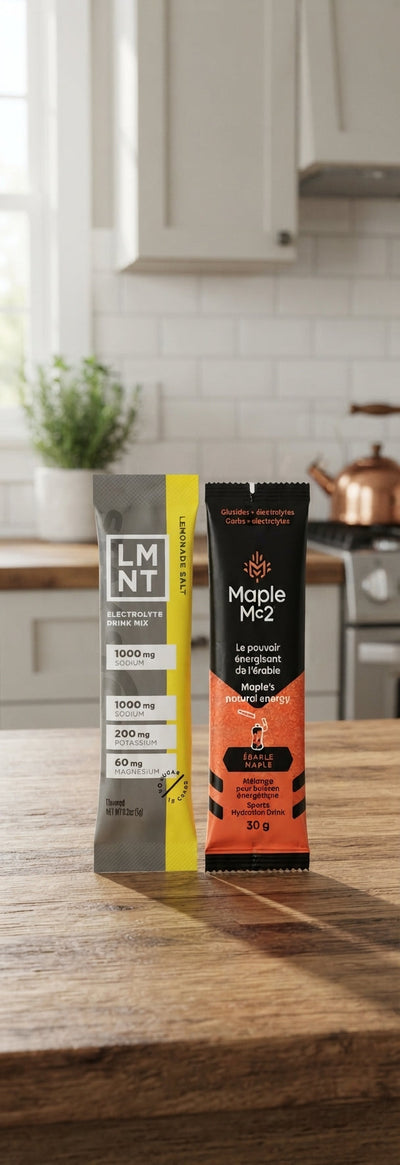
A powder like LMNT has 1,000 mg of sodium, 200 mg of potassium and 60 mg of magnesium per stick, with no sugar (manufacturer's product page). That is far more sodium than any bottle in the table.
The trade-off: no carbohydrates for energy, and a salty taste not everyone likes.
Our comparison of natural alternatives to LMNT covers the options for Canada. And if you are torn between powder and liquid, we also wrote about which format suits you best.
Why maple syrup changes the game
Maple syrup is a natural product, but concentrated and processed into an ingredient that is far more consistent than a fresh fruit. That is what makes it possible to build a natural drink with a known dose.
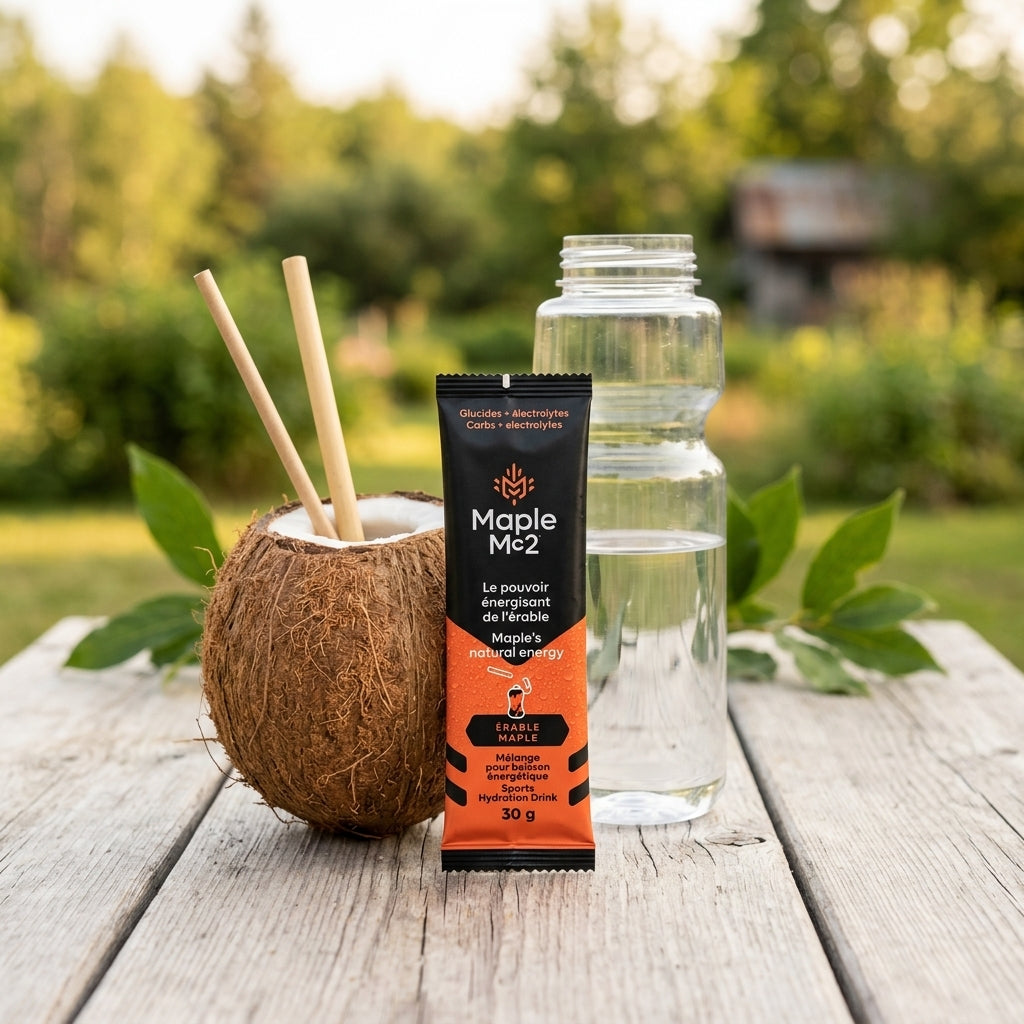
A 30 g Maple MC2 sachet, mixed into 500 ml of water, contains:
- 273 mg of sodium
- 94 mg of potassium
- 47 mg of calcium
- 28 g of carbohydrates, including 14 g of sugars
- 110 kcal
The ingredients: maple syrup, salt, freeze-dried fruit and natural flavours. No dyes, no synthetic sweeteners, no added sugar other than the syrup itself.
It has limits too. One sachet suits an effort of about an hour to 90 minutes. Beyond that, or when you sweat heavily, a powder with more concentrated sodium may serve you better, or you can simply take a second sachet.
Try all three flavours
Maple, Maple-Blueberry, Maple-Peach. 12 sachets to find your favourite.
Discovery Box | $29.99Looking for a local point of comparison? We also compared Maple MC2 with other maple drinks in Maple 3 Sport vs Maple MC2, and with classic sports drinks in our natural alternative to Gatorade.
Depending on your effort: what to choose?
The right choice depends on what you are doing, not on a universal rule.
Light effort, under 60 minutes
Brisk walk, yoga, mobility. Water is enough most of the time, and coconut water is a good pick if you like the taste.
You do not need extra sodium for this kind of effort.
Weight training and gym sessions
For a session under an hour, coconut water covers your potassium needs without loading you with calories. If the session drags on or the gym is hot, look at sodium.
A 10 km run, a 90-minute bike ride
This is where the sodium question becomes concrete. You lose it faster than you take it in with a coconut water of unknown brand.
Pick a drink whose sodium per serving you know. To plan your hydration during the effort, read our article on how to hydrate while running.

Heat and heavy sweating
Humid summer, long distance in the sun. This is the scenario where sodium changes everything.
- Mix your drink before you leave
- Sip regularly, not all at once
- Add plain water if the effort goes past 90 minutes

How to read a label before you buy
Whether it is coconut water or a sports drink, the label tells you almost everything. Three things to look at:
- The serving size: a 710 ml bottle counts as more than one serving, so compare per 100 ml like in the table above
- The sodium: it is the line that matters when you sweat a lot
- The ingredient list: the shorter it is, the easier it is to understand
For coconut water, look for "100% pure" or "unsweetened". Some flavoured versions contain added sugar.
Everyday hydration or sports hydration?
Your needs are not the same depending on the time of day.
At the office or on a regular day, water is still the best choice. Neither coconut water nor a sports drink is needed if you are not sweating.
It is when your body loses sodium through sweat, while training, working outside or walking a long way in the heat, that an electrolyte drink becomes useful. For lighter use, take a look at our everyday active life collection.
And after the effort?
Coconut water and electrolyte drinks also come up in conversations about recovery. Needs change: you have to rebuild glycogen, not just electrolytes.
Our recovery collection and the article what to drink after a workout go further. Prefer to make everything yourself? Read homemade vs store-bought sports drink.
Price and shipping
A Maple MC2 sachet costs $2.79 on its own, or $29.99 for a box of 12, about $2.50 per sachet. With a subscription, the box drops to $26.99, or $2.25 per sachet.
Shipping is free on orders of $50 or more.
Maple MC2 is made at Ferme St-Ours, in Montérégie, with organic Quebec maple syrup.
Frequently asked questions

In summary
On one side, coconut water: natural, rich in potassium, but with sodium that changes from one bottle to the next. On the other, sports drinks: precisely dosed, but loaded with sugar and dyes.
For an hour-long effort, both hydrate equally well. For a longer one, sodium is the number you need to be able to count on.
Maple syrup gives you both: a natural ingredient and a known dose. Discover Maple, Maple-Blueberry and Maple-Peach, or start with the Discovery Box.