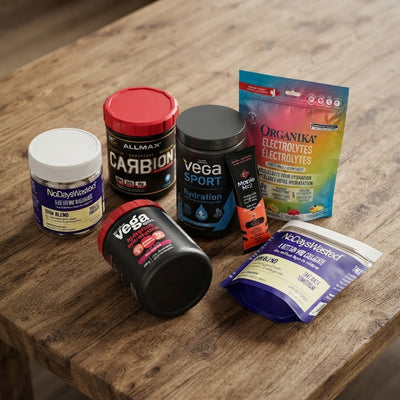
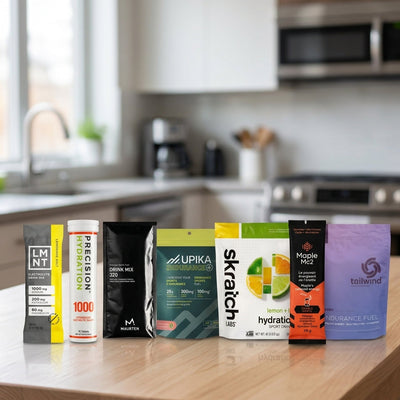
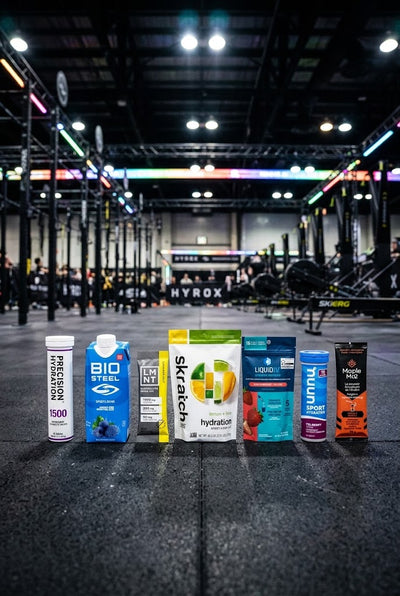
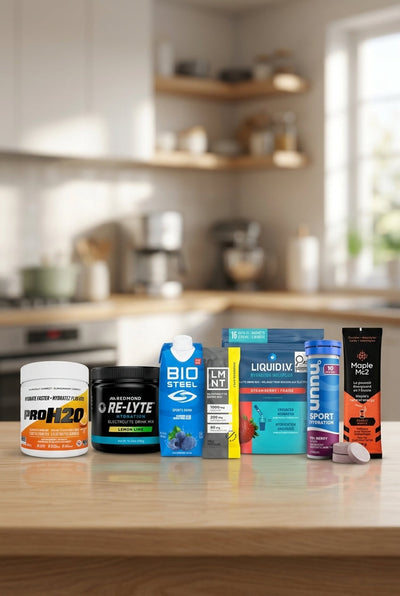
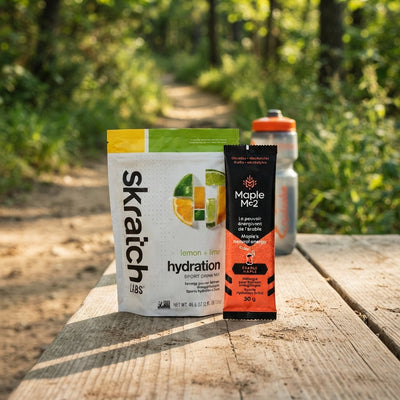
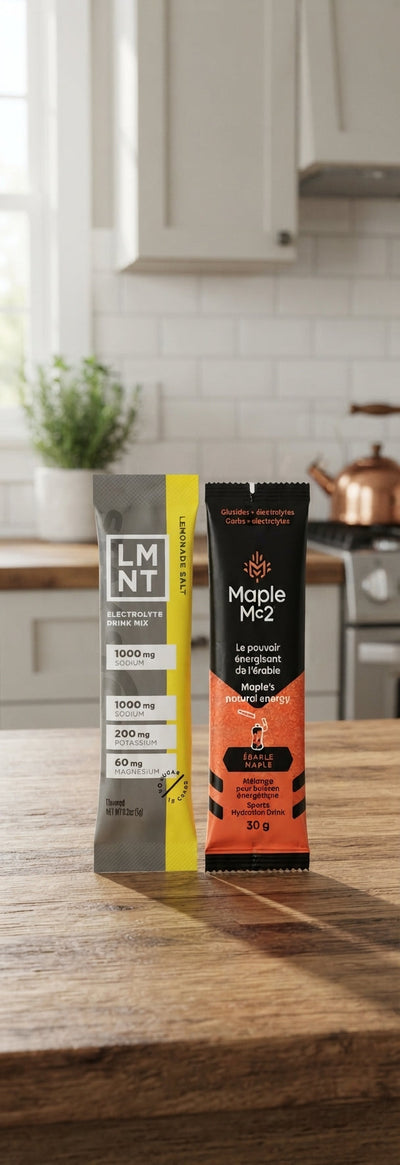
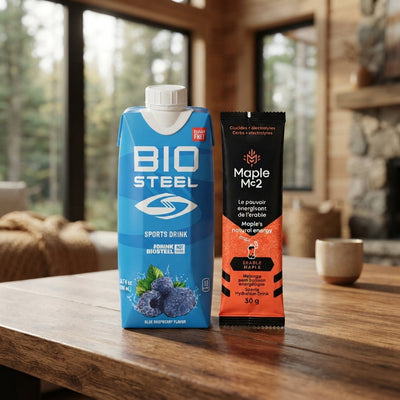
Grab two sports drinks. One fluorescent plastic bottle. One organic maple syrup sachet.
Flip both over. Read the ingredient lists.
On one side:
- Maltodextrin
- Artificial colors
- Synthetic sweeteners
- Artificial flavors
- Chemical preservatives
On the other: maple syrup, salt, freeze-dried fruit, natural flavors. Four lines.
The difference between an organic vs. conventional sports drink isn't about marketing. It's in these two lists.
Organic vs. Conventional Sports Drink: The Real Difference
The word "organic" isn't just a sales pitch. In Canada, it's a legal status.
A conventional sports drink is made to be shelf-stable, brightly colored to be recognizable, and sweetened to be as cheap as possible to produce.
An organic sports drink starts from a different principle: ingredients grown without synthetic pesticides, without GMOs, and processed with as few additives as possible.

Specifically, this changes three things:
- The origin of carbohydrates (refined sugar vs. natural sugar like maple)
- The presence or absence of pesticide residues
- The number of synthetic additives in the finished product
This is the starting point for the rest of this article.
*Here we will refer to a conventional sports drink as a regular sports drink, as this is what most people say to refer to a conventional drink.
What's Really in a Regular Sports Drink
The majority of sports drinks sold in grocery stores and pharmacies in Quebec share the same base.
- Maltodextrin or glucose-fructose syrup as the main carbohydrate source
- Artificial colors (often Sunset Yellow FCF, Allura Red AC, Brilliant Blue FCF) for bright color
- Synthetic sweeteners (sucralose, acesulfame-K) in "zero" versions
- Disodium EDTA as a preservative
- Artificial flavors to mimic fruit taste
None of these ingredients are grown. They are manufactured in a chemical plant, then added to the product.

This is what allows these drinks to cost around $2.50 for a 710 mL size. But there's a price elsewhere.
Key Takeaway
The glycemic index of refined sugar is between 85 and 105. That of maple syrup is 54. A lower GI means more stable energy during exercise, without a peak followed by a crash.
What Exactly Does "Organic" Mean in Canada?
The word "organic" is governed by a federal standard, not just a marketing label.
For a food product to bear the "Canada Organic" logo in Canada, it must comply with standards CAN/CGSB-32.310 and CAN/CGSB-32.311, verified by a certification body accredited by the Canadian Food Inspection Agency.
The main rules:
- Minimum 95% of ingredients must be certified organic
- No synthetic pesticides, chemical fertilizers, or GMOs in production
- Annual audit by an independent certification body
- Complete traceability, from cultivation to finished product
A conventional sports drink has none of these obligations. It can use any ingredient approved by Health Canada, regardless of the cultivation method.
Organic Maple Syrup: What Certification Specifically Changes at the Sugar Bush
“Organic” is not just a word on a label; it’s a precise production method at the sugar bush.
- No synthetic pesticides used on the land
- No formaldehyde in tapholes, a practice already banned in Canada but not widely known by the public
- Food-grade tubing for sap collection
- Annual inspection by an independent certification body
It is this level of rigor that distinguishes a certified organic sugar bush, like Ferme St-Ours, from a conventional one.
Pesticides and Residues: What Science Says

This is where organic vs. conventional stops being a matter of taste.
A synthesis of studies by Barański et al. (British Journal of Nutrition, 2014) on pesticide residues shows that certified organic products have detectable residues about 5 times less often than equivalent conventional products. Approximately 10% of organic samples contain quantifiable residues, compared to 48% for conventional samples.
For a sports drink, this counts double. You consume it during exercise, when your digestive and cardiovascular systems are already working at full capacity.
It's not a question of immediate danger. It's a question of cumulative exposure, glass after glass, week after week.
What "Organic" Doesn't Guarantee
Being honest about the limits of the word "organic" makes the argument stronger, not weaker.
- Organic does not mean a better nutritional profile: the sodium, potassium, and carbohydrates in an organic drink are not automatically superior
- Organic does not mean better performance: no study shows that an organic drink directly improves athletic performance
- Organic does not mean zero sugar: maple syrup is still a sugar, organic or not
What "organic" guarantees, concretely, is a regulated and verified cultivation method. Nothing more, nothing less.
Artificial Colors and Sweeteners: Impact on Your Body During Exercise
Artificial colors are not just an aesthetic matter.
They provide no nutritional or ergogenic function: they only serve to make the product visually more attractive, without contributing to hydration, energy, or recovery.
In active adults, the neurological effect of these dyes is poorly documented. But the principle remains the same: these are synthetic molecules that your body doesn't need to process to perform.
And artificial sweeteners like sucralose or acesulfame-K pose another problem, well known to athletes:
- Persistent chemical taste during exercise
- Digestive discomfort reported by some users
- No real energy intake (therefore no fuel for the muscle)
An organic sports drink eliminates this problem at the source: no additives to digest, only carbohydrates that the body recognizes.
Try all three flavors
Maple, Maple-Blueberry, Maple-Peach. 12 sachets to find your favorite, with no additives to digest.
Discovery Box | $29.99Organic Maple, the Base of a Truly Clean Sports Drink

Maple MC2 is made in Saint-Ours, Montérégie, from organic maple syrup.
One sachet contains:
- 273 mg of sodium
- 94 mg of potassium
- 47 mg of calcium
- 15 mg of magnesium
- 414 mg of total electrolytes
- 110 kcal and 28 g of carbohydrates
Carbohydrates and some minerals come from maple syrup. Sodium is provided by salt, as in any sports drink, including homemade recipes. The difference with an industrial formula is not the absence of salt, it's the absence of maltodextrin, artificial colors, and synthetic sweeteners.
Maple syrup also contains over 60 bioactive compounds, including antioxidants that simply don't exist in refined sugar or industrial maltodextrin.
How many sports drinks are actually certified organic in Canada?
It's difficult to quantify precisely, but by scanning the shelves and official websites of brands available in Quebec, very few display verifiable organic certification on the finished product itself. The majority of drinks that claim to be "organic" or "natural" are actually based on a certified ingredient, not on the entire product. For a detailed brand-by-brand ranking, consult our ranking of organic sports drinks in Quebec.
Digestion during exercise: why organic has an advantage
Bloating during exercise is a real problem. Often, the cause comes from the ingredients, not the effort itself.
Maple syrup is naturally low in FODMAPs, unlike several sweeteners and glucose-fructose syrups that ferment in the gut and cause discomfort.
A study on maple-based drinks conducted with 76 subjects also observed good digestive tolerance compared to conventional sports drinks.
Researchers at Laval University also studied the effect of maple syrup on the intestinal microbiota in mice, with favorable results on carbohydrate digestion. The results remain to be confirmed in humans.
For a digestive system already stressed by exercise, fewer additives to process means less risk of discomfort.
Comparative Table: Organic vs. Conventional Sports Drink
| Criteria | Industrial Sports Drink | Maple MC2 |
|---|---|---|
| Carbohydrate source | Maltodextrin, glucose-fructose syrup | Organic maple syrup |
| Glycemic Index | 85 to 105 | 54 |
| Colorants | Often present (Sunset Yellow FCF, Allura Red AC...) | None |
| Artificial sweeteners | Frequent in "zero" versions | None |
| Pesticides / residues | Possible, unregulated | Prohibited under organic certification |
| FODMAP Profile | Variable, often high | Low |
| Origin | Generally imported / multinational | Saint-Ours, Quebec |
Does organic cost more: myth or reality?
Not necessarily.
Although many brands leverage their "organic" angle and inflate their prices, it is entirely possible to find brands that have competitive prices with conventional drinks.
For example, a Maple MC2 sachet costs $2.50, compared to approximately $2.50 for a 710 mL size of conventional sports drink.
But the raw comparison hides two things:
- The cost of organic certification and cultivation without synthetic pesticides
- The absence of dilution: no cheap water added, no inexpensive sugar filler to inflate volume
The real calculation is based on what you get per serving:
- real electrolytes,
- stable energy, and
- zero additives for your body to digest during exercise.
How to Choose Your Organic Sports Drink Based on Your Training

Before exercise
One sachet 30 to 45 minutes before starting is enough to prepare the body without digestive overload.
During exercise: organic vs. conventional sports drink in real use
For efforts lasting more than an hour, aim for 1 sachet every 45 to 60 minutes. Unlike very sweet conventional drinks, maple does not cause a peak followed by an energy crash. To calculate your needs during exercise in more detail, consult our article how to hydrate during a run.
After exercise
One sachet for recovery helps replenish sodium and potassium reserves lost in sweat, without adding superfluous additives to an already tired body.
Frequently Asked Questions
In summary
On one side: a conventional sports drink, refined sugar, artificial colors, possible pesticide residues.
On the other: an organic sports drink, certified maple syrup, zero synthetic additives, natural electrolytes.
The comparison between organic and conventional sports drinks boils down to a simple question: what do you really want to put into your body during exercise?
Discover the three flavors: Maple, Maple-Blueberry, Maple-Peach, or start with the Discovery Box to try them all.